Showing posts with label motion picture industry. Show all posts

Saturday, September 21, 2024

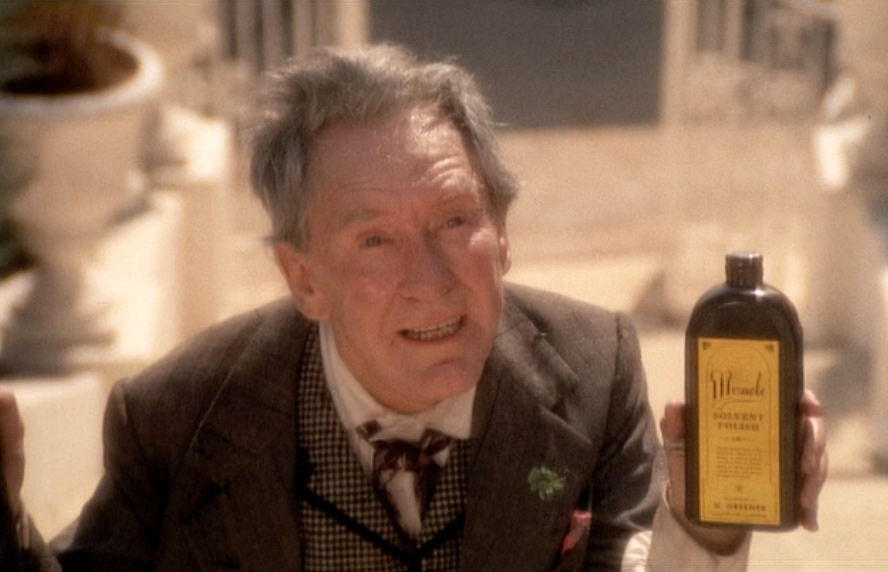
any dream was better than no dream ... The Day of the Locust (1975)


   The Day of the Locust [DVD]. Hollywood, Calif.: Paramount Pictures, 2004. John Schlesinger, director. Based on the novel by Nathanael West. Director of photography, Conrad Hall; music, John Barry; editor, Jim Clark. Summary: a naive young set designer seeks work in Tinseltown and falls in love with an aspiring actress who lives with her alcoholic father, a former vaudevillian entertainer turned snake oil salesman. Originally produced as a motion picture in 1975. Performers: Karen Black, Burgess Meredith, Donald Sutherland, William Atherton, Richard A. Dysart, Geraldine Page, Paul Stewart.


     John Schlesinger’s bitterly sardonic take on Nathanael West’s blistering novel hasn’t lost any of its bite even today, a half century later. Alas, like West’s novel, the film version languishes under the radar, and indeed a reconsideration of both is long overdue [1]. Day of the Locust is in the tradition of such gloves-off portrayals of the dark side of the movie business the likes of Sunset Boulevard and The Bad and the Beautiful, just more so. At 144 minutes Locust is a tad long with many weird detours, dead ends and lost weekends, but director Schlesinger keeps things moving apace so well that we don’t really notice.    

     First, a comment on the look of the movie. Locust is at heart a dark fairy tale – some would say a horror film – that takes place (nearly) nine decades ago. Yes, it’s still the Depression [2]. Thus it deserves a strange look, and gets it, filmed through a mist-like gauzy overlay that actually adds to the film’s mystique. Moreover, the story is rendered through a prism of mid 1970s cinéma vérité aesthetic, Seventies style slice-of-life chic if you will, but in this case a glamorous, if falsely so, slice.

     For me the centerpiece of the film, figuratively and literally – it takes place about half way through – is the visit to Big Sister’s revival. It breezes by much too quickly and ostensibly doesn’t have a lot to do with the Hollywood milieu, then again maybe it does. The revival meeting's schtick is really a massive production number that mirrors the hype and glitz of Hollywood productions. Entertainment and show business by any other name, while the ka-ching of cash registers and the counting of money provide a realpolitik if admittedly heavy-handed obbligato [3]. Moreover, the religious frenzy at the revival parallels the later, gaudy opening night extravaganza, complete with de rigueur searchlights, of DeMille’s The Buccaneer. In the latter the potential for violence releases itself in an orgy of destruction and rampant savagery that still shocks even today in our supposedly seen-and-heard-it-all world. Perhaps the gala opening is a metaphor for American society itself in the Thirties, but it actually comes too close for comfort in our supposedly more enlightened 21st Century: the fans who jostle, shove and gouge for a glimpse of the god- and goddess-like stars are selfish, materialistic sorts, obsessed with the glamor of the illusion, or is it the illusion of glamour? Either way, the various losers, hangers-on, and assorted white trash that do their best to crash the première mirror the locust-like little people that litter the film and which Tod keeps bumping into. In Nathanael West’s vision even those on the inside or the fringes will be pulled down into the Hadean cauldron with the rest of us ordinary mortals. And seemingly benign characters such as Hackett, Claude Estee and Helverston, because of their very casual cruelty and aloofness to the industry's savage indifference to the little guy, are more loathsome than the various abrasive grotesques that flit in and out.
    By the way, Geraldine Page is wonderful as the evangelist with pizazz, the aforementioned Big Sister, one of those offbeat characters she does so well. The role actually anticipates – by nearly a half century – similar characters in the television miniseries Penny Dreadful: City of Angels and Perry Mason (they just love including those Thirties-era spiritual leaders as secondary characters in Hollywood period pieces). As the fellow said, the end times may be upon us, but they can be very entertaining. 

     But in a movie of myriad disturbing images and scenes, for me the most brutal and heartless of the lot is the impromptu cockfight which looks all the world like the real thing. Truly a heartbreaking result as a bloodied animal lies on the floor, probably mortally wounded. Perhaps appropriately, after the cockfight the spectators enjoy a dinner party that transitions to a kind of PG-rated bacchanal, with Faye as the main attraction.

"magic is what I'm selling"
     But getting back to humans, the various losers, grotesques and other outsiders who populate Locust, waiting at the stop sign of life for their one big break, are actually depicted in one of Hackett’s tableau as three chalk faced folks wait on a bench at a bus stop. West himself had a love-hate relationship with the film industry that mirrored his own contradictory nature: he was both a romantic and cynic; a plagiarist who was also a gifted, original writer; a savage critic of the Hollywood dream who never quite gave up on the dream.

     In any case, West knew of what he spoke: he toiled as a writer of B scripts and like Locust’s hero Tod Hackett lived in dive hotels and run-down apartments. He knew all too well the labyrinthine mechanics of the movie business and the frustrations of the extras, bit players, assistant directors, and, lowest of all, writers. Tod Hackett, Locust’s hero and arguably a West self-portrait, is one of the few haves in a world of have-nots. A rather high-minded artiste just beginning his career as a set designer, he struggles to come to terms with going Hollywood, and appropriately his opus maximus, created on the sly, is a painterly tableau titled “The Burning of Los Angeles.”
     Along the way Hackett encounters various seedy and colorful characters, among them an actress neighbor who catches his eye. He also crosses paths with the actress’s father, a washed-up vaudevillian turned snake oil salesman, as well as a certain Homer Simpson, onetime accountant convalescing in California’s balmy climate. Monosyllabic cowboys, amorous Mexicans, and a curmudgeonly midget named Abe Kusich add to the mix. Not many of the characters who populate Locust are likable, not even the ostensible good guy Tod. But that was the idea: West wanted to portray the desperate low-lifes and perpetual wannabes existing under the façade of Hollywood glitz and glamour. Unpalatable the little people may be, we still feel sympathy for them and this is part of West’s genius.

     All these elements are beautifully realized by the film, especially the performances, which are generally over-the-top, and rightly so. This makes them so on the money because the exaggerated deliveries are in their way genuine, masking as they do the desperation and disappointment the characters feel. Meriting a singling out are Karen Black in the performance of a career as the vacuous Faye Greener, Burgess Meredith as Faye’s alcoholic father, Natalie Schafer as brothel madam Audrey (a long way from hoity-toity Mrs. Howell), and the great Billy Barty as the obstreperous dwarf Abe Kusich. More sedate are a bland William Atherton as our nominal hero Tod Hackett and Richard Dysart as a cold fish Hollywood executive with a taste for softcore porn and high class call girls. Good performances, true, by Atherton and Dysart but as haves in a world of have nots their characters can afford to be more guarded and reserved. Contrary to the critical and fan rave reviews for Donald Sutherland, I wasn’t taken with his zombie-like interpretation of the Homer Simpson.

     My only complaint is that the Paramount DVD has zero bonus features, a major oversight considering the film’s literary, historic and aesthetic connections. There seems to be a ‘limited edition’ blu-ray, which I understand has a generous sampling of supplements. And this is only just. Day of the Locust is a forgotten masterpiece that deserves a presentation and packaging worthy of its stature.   

   [1] To be technically correct, academics and cultists have long been familiar with West’s magnum opus, but among the general public West doesn’t have the high profile of the likes of Hammett, Chandler, and Cain.  

   [2] I may have missed it but I don’t recall any overt references to the year in which Locust is taking place. But from all the clues we’re given I place it to be ca. 1938.

   [3] The show biz connection couldn't be made plainer when Harry hallucinates that his on-stage 'cure' is another performance and the ecstatic faithful are his audience. 'I stole the show,' he later reminisces.


Saturday, July 2, 2022

enigmatic rebel: Ann Dvorak

    Rice, Christina. Ann Dvorak: Hollywood’s Forgotten Rebel. Lexington, KY, University Press of Kentucky, 2013.

     From 1930 to 1934 a group of amazing little films burst onto the motion picture scene, much to the chagrin of self-appointed moralists. These movies, which today we dub pre-Codes, presented a rawer, more realistic view of the human condition, and by implication, they were a blistering critique of American society in general. Among other qualities, pre-Code films were notable for their fast pacing, snappy dialogue, edgy stories, lean, mean set designs, and most of all, tough, worldly-wise characters who more often than not were driven by self-interest, self-indulgence, sensuality, and quick fixes, including (sometimes unpunished) crime. All was presented in just an hour or so and with an obvious theatrical pedigree. In short, the pre-Code movies just had a different look and feel about them. However, under growing public pressure and threats of boycotts, the motion picture industry initiated the Code-enforced era beginning July 1934, which insisted that movies present a more wholesome view of the world. The studios by and large obliged, and, as they say, the rest is history.
     Mirroring the era of pre-Code itself, the careers of many stars faded quickly in the mid and late Thirties. These former luminaries are little more than footnotes in cinema history, and they include once big names, today largely forgotten, like Ruth Chatterton, Miriam Hopkins, Karen Morley, Dorothy Burgess, Ann Harding, Mae Marsh, Ruth Donnelly, Glenda Farrell, David Manners, Warren William, Chester Morris, Mae Clark, and Dorothy Mackaill. Alas, for a number of reasons both personal and professional, Ann Dvorak was one of the casualties whose promise never blossomed to the extent that seemed inevitable in her peak year of 1932. Looked at objectively, her career arc is spotty at best, but devotees relish her performances in the pre-Codes, especially Scarface and Three on a Match, two of her best loved films. A fun bit of trivia is that she appeared as Della Street in an early film version of a Perry Mason mystery, The Case of the Stuttering Bishop (1937). But Ann Dvorak had a talent for self-destruction: she committed the unpardonable sin of challenging the big studios (she tussled with Warners over her contract amid rancorous legal battles). As was the norm in them days, she lost. A couple years later Warners let her go, and she was determined never to attach herself to a major studio again; she was now a free agent. But her career never fully recovered. She was an ambulance driver in London in World War II and later in the Forties was mostly relegated to B movies and bit parts. A starring role of some interest during this time was her appearance in The Private Affairs of Bel-Ami (1947), with George Sanders.
     She left movies altogether in 1951 at the age of forty. In addition to being a rebel and free spirit, Ann Dvorak was that rare bird in golden age Hollywood: a film star who was an intellectual. Her cerebral pursuits included horticulture, book collecting, writing (a pet project was a history of the world), and most improbably, bacteriology. She spent her final years in Honolulu living in obscurity and semi-poverty and died in 1979 at the – by today’s standards – relatively youthful age of sixty-eight. But due to a number of factors – the revival of interest in pre-Code movies and their exposure via TCM, DVDs and theatrical releases; a growing online presence via various tributes and posts; and not least of all, Christina Rice’s marvelous biography – Ann Dvorak’s star has brightened in recent years and she’s finally getting the recognition denied her for decades.
     Christina Rice’s Ann Dvorak: Hollywood’s Forgotten Rebel is a triumph. As the author points out tracking down information on such an under-the-radar subject was not an easy task, to say nothing of locating folks who had actually known her personally. But she persisted and her tome is veritably a model for a star biography, and especially for a biography of a once (near) major star who had faded from public view. The book then is a felicitous balance of the scholarly and the popular: reader-friendly but having the usual academic patina in the form of extensive index, notes and reading list, and a complete filmography. Especially noteworthy are the many photographs – most of them culled from the author’s private collection – of the eminently photogenic Miss Dvorak, even when she’s a bit worse-for-wear. It’s obvious Rice has a genuine affection for her subject but manages an objective view, and the sympathetic biography nicely balances professional and personal elements. As expected the big movies receive more extensive treatment but the lesser ones get respectable coverage as well. While we may infer that indeed Ann Dvorak appeared in her share of mediocre movies, even a few bad ones, she brought class and professionalism to every film she was in. The recalling of Dvorak’s attempts to challenge the big studios, mostly on contracts, reminds us of the power of the studio system in moviedom’s ‘golden age’ (the 1930s and 1940s), and the near slave-like hold the corporate giants had over its stars, both major and minor.
     For ultimately the Ann Dvorak story isn’t unique in the annals of the entertainment industry, and like other performers with unfulfilled careers, any number of wha-if type questions arise. Would things have turned out differently if she hadn’t been so headstrong and hadn’t challenged the big studios early in her career; if only she’d played the game in the usual way and remained patient and let her career develop along more conventional lines; if she had gotten the role of Sadie Thompson in Rain, rather than losing out to Joan Crawford; if she hadn’t left the movies at such a relatively young age. Alas, as in all these kinds of questions, we have that always frustrating and unsatisfying answer: we’ll never know. What we do know is what she did, and, as much as is possible, who she was. But mostly we have her best films, those handful of pre-Codes, and for that we’re the richer. 

Tuesday, February 2, 2021

who are the greatest geniuses in cinema history?

 We admire geniuses, we love them, but they discourage us. They are great concentrations of intellect and emotion, we feel that they have soaked up all the available power, monopolizing it and leaving none for us. We feel that if we cannot be as they, we can be nothing. Beside them we are so plain, so hopelessly threadbare. How they glitter, and with what an imperious way they seem to deal with circumstances, even when they are wrong.

   - Lionel Trilling, Introduction to Orwell's Homage to Catalonia


   The idea of genius, along with attempts to explain or define it, has always been a slippery slope. Greater thinkers than I have opined on the subject, at length, and there’s no shortage of commentaries on the ‘Net. But just what is genius? What are its precise boundaries?
Is genius something we’re born with, or can it be learned and cultivated? Are ‘geniuses’ that different from the rest of us? Do some individuals simply have a greater flair for publicity and image? Who can say where genius ends and self-promotion begins? Are 'geniuses' really grifters in disguise?

   Or do those we deem genius simply have more energy, determination and persistence than the rest of us? Were these the only qualities necessary then figures like Ed Wood and Harry Stephen Keeler would be right up there among the all time greats. And for all their respective cult followings, the conventional wisdom would vote against calling Wood or Keeler a genius. Obviously some qualitative factors have to enter into the equation: at minimum a true genius has to be good at his chosen artistic (or otherwise) mode of expression.

   But more to the point, how can we apply the notion of genius to the movies? [1] Does it even make sense to mention the term in connection with the movies? Interesting that other art forms – music, literature, painting, sculpture – have canons that are pretty well solidified. Accordingly, the individuals who merit the title have long been identified.

   However … (and it’s a big however), film is a unique art form. Among other things it combines several art forms in its final product, all of which makes it more difficult to arrive at parameters, much less who qualifies. The challenges, it seems, are many, but can be broken down into a few basics. First, for all the huffing and puffing of the auteur theory, film is ultimately a collaborative art (alas, among the downsides of said collaborative art is studio interference in the finished product, perhaps most [in]famously practiced in the various mangled productions of Orson Welles). There's also the reality that film is largely dominated by technology, and the witches’ brew final product is almost always a case of the whole never quite equaling the sum of the parts. The other issue is that cinema is, for better or worse, a quintessentially commercial art, and matters of aesthetics can never be completely separated from mass, some would say crass, consumerism.

   Further, movies didn’t always have the highbrow cachet they enjoy today. Indeed, for the first half century or so of their very existence the movies were viewed as a commodity, and the idea that they were great art was considered folly at best. All that changed in 1952 with the U. S. Supreme Court’s decision on Joseph Burstyn, Inc. v. Wilson (also referred to as the Miracle Decision) in which the court held that cinema was indeed an artistic medium and among other things entitled to First Amendment protection.

   For our deliberations here, however, it’s the aforementioned collaborative nature of cinema that’s the monkey wrench. To wit, and for better or worse, in the context of cinema we use the term ‘genius’ almost solely in connection with directors [2]. Occasionally screenwriters, cinematographers, and performers get a mention, and, very occasionally, producers. But this reveals a decided prejudice for the creative side and diminishes those active in the, arguably equally important, technical, management and promotional areas.
In the technical and -like areas, along with the obvious candidates of editors and cinematographers, do we include wardrobe designers, art directors, set designers, special effects wizards, makeup artists, hairdressers, film restoration specialists, titles designers?

   If we define genius as someone who made a signal impact and influence on the art, we’d have to give serious consideration to the much maligned movie moguls, especially those of the Golden Age, the Harry Cohns and Louis Mayers of this world, alongside the more aesthetically correct auteur producers like Val Lewton, Irving Thalberg and Daryl Zanuck. But if we include studio executives, how about the powers behind the throne like Ida Koverman at MGM during Mayer’s reign? And while we’re talking management, should agents figure into the mix? In the technical department, a case might be made for Technicolor guru Natalie Kalmus.

   Whatever the parameters, be they aesthetic, commercial or technical, is a consistent body of high level work over a long period of time sufficient? Do we forgive the occasional misfire? Is one transcendent work sufficient? Do historical elements figure into the mix? Are the works of Sofia Coppola and Kathryn Bigelow less significant because they appeared a century after those of Lois Weber and Germaine Dulac?

   Here I invoke the oft-noted and self-defeating caveat that it’s meaningless to create lists like these, perhaps worse than meaningless, since tastes, perceptions, and even definitions inevitably change over time (translation: it’s all very subjective). And yet, and for all my long winded reservations above, I thought it might be fun to list my choices of the top ten cinematic geniuses of all time. It pained me to cut it off at ten – I was tempted to lengthen it to twenty. (Confession: there are two ties, so to be perfectly technical, this is a list of twelve). In any event, as a compromise I include an honorable mention section of arguably lesser lights whose contributions, while significant, and all possessing at least some spark of genius, were nonetheless in my opinion more specialized or of a lesser degree in areas like aesthetics, impact, and influence.

   I’ll admit my selections betray a certain favoritism for the offbeat, experimental, independent and subversive. There’s also an undeniable Hollywood/Euro bias, along with a preference for the artistic side over the technical or managerial. Still, perspicacious readers may find themselves scratching their heads at the absence of some pretty big names. Indeed, a few of the entries, especially the honorable mentions, may well be cringe inducing to some tastes. And no, in case you wondered, Ed Wood doesn’t make the cut, though the thought did occur to me. Nonetheless, and echoing the sentiment above, some of the all-time greats are conspicuously absent. They are familiar and we needn’t mention them by name. In one sense these greats of cinema, and here I refer mostly to directors, made the same film over and over, and did so supremely well within the confines of budget, studio, genre and era. The stories, performers and techniques may have varied, but the underlying philosophic and aesthetic vision was always the same, most of the time anyway. Such individuals were expert at creating expert films, films that were exceptionally well made but lacking that special something – dare I say, genius – that characterizes the work of perhaps less proficient, less consistent, artists who nonetheless created films that were more compelling and exciting.

   In any event, my own bottom line: to be designated a cinematic genius, an individual had to create works that were not only of high intrinsic value, but more important, new, exciting or groundbreaking, that allowed us to experience the medium, and by extension the world, and perhaps ourselves, in fresh and unexplored ways. Helming a work, or works, that today we consider revolutionary wasn’t a requirement, but it didn’t hurt. 

   I lean toward multi-taskers philosophically, and depending on how one defines these things, a majority of my top ten might be considered such, less so for the honorable mentions. In any case most of the top tier choices are hardly shocking, though a couple may raise eyebrows. It’s obvious I prefer the old over the new: the test of time has to count for something. On the other hand, as opined above, even a consistently high level of work over time in itself doesn’t qualify as genius [3]. I’ve demurred from any life’s work summaries as most of the folks on the list have had a ton written about them already. So, with drumroll, my choices are (listed more or less in chronological order):

Lois Weber
Charlie Chaplin
Fritz Lang
Irving Thalberg
Busby Berkeley
Orson Welles
tie: Val Lewton
       Maya Deren
Bernard Herrmann
Roger Corman
tie: Federico Fellini,
      Rainer Werner Fassbinder
  

  Honorable mention: John Alton, Kenneth Anger, Michelangelo Antonioni, Fred Astaire, Ingmar Bergan, Robert Bresson, Tod Browning, Jack Cardiff, William Castle, Jean Cocteau, Joan Crawford,  Walt Disney, Carl Dreyer, Germaine Dulac, Ray Harryhausen, Charles Laughton, Herschell Gordon Lewis, Peter Lorre, Guy Madden, Frances Marion, Georges Méliès,  Russ Meyer, Carmen Miranda, Alla Nazimova, Mabel Normand, Leni Riefenstahl, George Romero, Mack Sennett, Andrei Tarkovsky, Gregg Toland, Dalton Trumbo, Douglas Trumbull, Edgar Ulmer, Peter Ustinov, Jean Vigo, John Waters, James Whale, Daryl Zanuck.

[1] I’ve scoured the ‘Net and other sources and have yet to find a satisfactory definition, at least one that describes genius in scientific, measurable terms. Even the most reputable sources resort to a subjective, airy vagueness. This from the Cambridge Dictionary (actually a pretty good summary, but eminently lacking in particulars): “ … very great and rare natural ability or skill, especially in a particular area such as science or art.” Similarly the venerable OED chimes in with: “ … inborn exalted intellectual power; instinctive and extraordinary imaginative, creative, or inventive capacity, frequently opposed to talent.” Actually the OED version gets subtly closer to what I look for in a work or individual to merit the label ‘genius.’
    Still, such definitions are at best a good start; the phrases used to define genius could well describe any number of bright, talented folks who aren’t geniuses. What’s lacking is that special something, that magic that separates genius from the merely talented or gifted. The same principle applies to other, non-artistic, areas like physics, chemistry, mathematics, philosophy, and medicine. Then there are the problem fields like public service, commerce, sports and history. Can a head of state, government bureaucrat, military commander, lawyer, business tycoon, chess player, football coach, political operative, or historian (or any nonfiction author ... film critic, anyone?) ever merit the mantle of genius? By the way, not a new observation, but is genius merely the flip side, the sunny side if you like, of madness?

[2] Indeed, were a poll taken today to anoint the greatest cinema genius of all time, the consensus choice, at least among hardcore film buffs, would probably be Chaplin, though to be sure his would likely be a plurality choice. At the same time prestigious bodies routinely proclaim Hitchcock, Welles, or Ozu as the best director, though seldom Chaplin, all of which tends to illustrate just how elusive the concept can be.
* 
    Further confirmation of the vagaries of assigning a ranking of genius, as least as it applies to film history, is that only two of Chaplin's films, City Lights and Modern Times, even cracked the top 250 of the august BFI/Sight & Sound 2022 poll of the 'greatest movies of all time,' placing tied for 36th and tied for 78th respectively. Both are honorable if not exactly top tier rankings, and incredibly, both finished below the likes of Taxi Driver, Do the Right Thing, and Mulholland Dr. 
    Chaplin films do somewhat better in the, similarly much-cited, AFI Top 100 poll (2007), with City Lights, The Gold Rush, and Modern Times placing 11th, 58th, and 78th respectively. The caveat is that the AFI poll considers only American produced films, though it also includes a few British-made films that were financed by American studios.

    * In the same above -referenced BFI/S&S poll [2022] Chaplin chimed in at 27th in the 'greatest directors of all      
  time' category, below quite a few, arguably lesser, lights.


[3] One might also assert that the difference between genius and the exceptionally talented craftsman is a sometimes fuzzy one, and to take it one step further, what separates the reliable professional from the dreaded moniker hack can be a precariously thin line. It’s only fair to add that history has taught us that the studios, certainly in the studio era, (almost) always preferred a reliable craftsman/hack at the helm to an erratic genius. Plus ça change …

Further reading:

Marjorie Garber, “Our Genius Problem,” Atlantic Monthly, v290n5 (Dec. 2002): 64-72.
Darrin T. McMahon, Divine Fury: A History of Genius, Basic Books, 2013.
Andrew Robinson, What Has Become of Genius?

Tuesday, January 5, 2021

fate takes an option: the mixed legacy of the Val Lewton horror unit at RKO

     The history of motion pictures is littered with tales of might-have-beens, false starts, and missed opportunities, all chronicled in sources as diverse as scholarly biographies to lurid scandal magazines. They tell of lives, today largely forgotten, of the once promising and can’t-miss future stars (writers and directors, too) that … weren’t.

     Especially compelling, and not so frequently examined, are the stories associated with a trend, genre or studio. An obvious example is the genre (or was it a style?) today we dub film noir, and the seemingly malevolent hold it had on the actors who portrayed the desperate characters in its cinematic universe. Indeed, their private lives were often more noir than the (anti)-heroes and -heroines they impersonated onscreen. To wit: in one of the more infelicitous timings in American cultural history, the noir era counted among its ranks not only actors but many directors and screenwriters with leftist political sympathies. Thus their fate: the persecution by the infamous House Un-American Activities Committee and -like groups, one of the results being the blacklisting of not a few unfortunate souls. It's probably the most conspicuous example of the curse of noir and its extension to real life drama [1].

     But we’d like to focus on another, less well-known, group of ill-fated individuals, with their own attendant maledictions. They were associated with the production unit at RKO Pictures specializing in horror films in the 1940s heralded by maverick producer Val Lewton. The nine films Lewton oversaw from 1942 to 1946 created and perfected the sub-genre of supernatural noir. Conveyed through an aesthetic language similar to that of film noir, these hymns to the night shared with noir a fatalistic, no-exit pessimism and dark world view, though of a different kind [2].

     Usually seeking material gain, the edgy characters in noir employed methods both legal and otherwise to achieve their aims, and were often menaced, or manipulated, by powerful, mysterious forces. Sometimes the forces were not so mysterious, but nonetheless eminently threatening – state officialdom, criminal elements, hostile foreign powers, duplicitous femmes fatales. The protagonists in the Lewton films had their own issues, but they stemmed from within, to be precise from the subterranean realms of the human psyche, the result being an existential searching for something they, and often the audience, couldn’t quite get hold of [3]. Theirs was a quest for meaning and direction in a world that seemed devoid of meaning, and moreover arbitrary and chaotic in its dispensation of fate.

     The characters in the Lewton films often confronted their issues by way of supernatural or other-worldly manifestations: a sexually repressed woman metamorphoses into a vicious panther; a lonely child summons an angel from the beyond; a doomed heroine seeks redemption by joining a devil cult; an adulteress becomes one of the walking dead; a no-nonsense general succumbs to ancient superstitions and eventual madness.

     In any event, and getting back to the notion of a Lewton curse, it’s only fair to list some exceptions, as any number of major and minor creative types associated with Val Lewton went on to successful, lengthy careers: directors Robert Wise, Mark Robson and Jacques Tourneur; composer Roy Webb; wardrobe designer Renié; cinematographer Nicholas Musuraca; art director Albert D'Agostino; and actors Boris Karloff, Kim Hunter, Anna Lee, Kent Smith and Henry Daniell. Moreover, not all the aborted careers were involuntary. Some were very much by choice, a prime example being Jane Randolph, so effective in Cat People and its quasi-sequel Curse of the Cat People. One of her best roles during this time was in the noir classic T-Men (1947), in which she was cast against type as a ruthless high level apparatchik in a counterfeiting scheme. The following year her career came to an inglorious end with her appearance in Abbott and Costello Meet Frankenstein, whereupon she left films, married a rich guy and lived out her life in Europe, mostly Spain, amid much material comfort.

     But among the less fortunate there’s quite a litany of unfulfilled promises, one-hit wonders, and should-have-beens. Of course the elephant in the living room is Val Lewton himself. So creative during his peak years at RKO (and before), upon his departure in 1947 he oversaw nothing of lasting value. Times, and tastes, were changing, and the new productions he supervised were critical and commercial failures. As a result of a weak heart and years of overwork, Lewton finally succumbed to heart failure in 1951 at forty-six years of age. In many ways Lewton’s was a tantalizingly brief and unfinished career, and we can only wonder what he might have accomplished had he lived longer, another twenty years, even ten years. Perhaps the old magic would have returned, perhaps not, but we’ll never know.

     There was also the eccentric screenwriter DeWitt Bodeen, whose career likewise peaked in the 1940s. He wrote the insightful scripts – arguably the best of all the Lewton films – for Cat People and The Seventh Victim, the latter co-written with Charles O’Neal [4]. But he did little of consequence after 1950, confining himself mostly to work in television and film criticism. He left Hollywood disillusioned and died in obscurity in 1988 at the age of 79.

     Bodeen's co-author on Victim, Charles O'Neal, lived a long life (he passed in 1996 at the age of 92), but his career as a screenwriter is spotty. He had a string of mostly B films in the Forties but his career stalled around 1950, after which he worked only sporadically, contributing mostly scripts for television.    


They walked with Val lewton 

Another writer casualty, this one a victim of the aforementioned anti-communist witch hunts of the late Forties and early Fifties, was screenwriter and Lewton stalwart Ardel Wray, who helmed the scripts for I Walked with a Zombie (co-written with Curt Siodmak), Leopard Man and Isle of the Dead. Her refusal to name names in 1948 effectively ended her tenure at Paramount, the studio where she was working at the time, and furthermore resulted in her blacklisting by the entire industry. Her career as a Hollywood screenwriter was now over, and she subsequently confined her work to various and odd jobs: script reader, story analyst, movie serializations, and especially script writing for television programs in the 1960s.

     But as for actors and actresses, a good place to start is Simone Simon, who had a fairly substantial career in her native France before coming to Hollywood in the late 1930s. She became a genuine star after Cat People in 1942, and she appeared in the sequel Curse of the Cat People two years later. But then her career went southward. She returned to France in the late Forties and her roles were spotty. Her best film during this time was La Ronde, after which she appeared in fewer films. She more or less left the movies altogether in 1956, although she did appear in one final film, The Woman in Blue, in 1973. Hers was a sketchy career, and her star burned bright only intermittently.
 

     Cat People’s other cat woman was portrayed by Lewton favorite Elizabeth Russell (she appeared in five of his films, always in cameos or supporting roles). Her post-Lewton career gradually faded and by 1960 she had left the movies altogether. With the renewed appreciation of the Lewton oeuvre in the 1980s and 1990s she became a kind of cult figure, but her glory days in the movies, focused as they were in the 1940s, were limited at best. Mary Halsey, who played the pert blonde desk attendant at Alice's hotel in Cat People, frequently appeared (mostly uncredited) in B movies in the Forties, but her career was to be short lived: her last film was in 1945. She passed in 1989 at the age of seventy-five.

     The other actor from Cat People that deserves a mention is Tom Conway, who also appeared in two other Lewton films, I Walked with a Zombie and The Seventh Victim. Born in St. Petersburg, Russia, Conway was the older brother of George Sanders and has been variously described as the nice George Sanders and, less generously, the B movie George Sanders. Perpetually on the fringe of stardom, Conway was under contract to RKO and enjoyed a mildly successful run in the Forties, especially for his appearing in ten Falcon mysteries. But in the Fifties his career slowed and substantial roles came few and far between. By the Sixties he was reduced to cameos and the occasional television appearance. His last credited role was on a Perry Mason episode in 1964, in which he essentially plays himself: a washed up theatrical actor given a raw deal by the industry, reduced to touring with a Shakespearean troupe who perform readings. Conway died at the age of sixty-two, destitute and severely alcoholic, in Culver City, California, in 1967.

     I Walked with a Zombie
, the film that followed Cat People and considered by some to be Lewton’s masterpiece, nonetheless had its share of casualties. Zombie’s leading lady was Frances Dee, and it’s certainly the performance she’s remembered for, but by this time her star was dimming. The rest of her career is obscure, if recalled at all. But in some respects she escaped the curse, living out a long, and by all accounts very prosperous life (she passed in 2004 at age 94).


     Tom Conway was Dee’s leading man in Zombie, but the titular character was played by Christine Gordon, whose (uncredited) credits include only five other films, all dating from the mid 1940s. But at least she has a modest place in cinema immortality as the catatonic Jessica who, appropriately enough perhaps, suffers a tragic fate in the film. An even smaller, if pivotal, role in Zombie is taken by the Panama born dancer Jieno Moxzer, who plays the voodoo priest. Moxzer’s only other film credit is Cabin in the Sky. Zombie also featured Sir Lancelot, a singer/actor who more or less cornered the market on the calypso singer cameo in the 1940s. He appeared in a string of films in the Forties, including appearances in three Lewton films. Lancelot had a long career as a singer, performing into his sixties, but by the late 1940s his career in film was essentially over. He died in 2001 at the age of 98.

     The next film, The Leopard Man, had at least four actresses whose careers were touched by the Lewton shroud. Three of them played the victims in Leopard Man and their acting tenures likewise  came to unfortunate or equivocal ends [5]. Incidentally, of the three Hispanic victims, two were played by Caucasian actresses, a fairly common practice in them days of casting ethnic roles with Anglo performers. In any case Leopard Man also included in its cast Isabel Jewell, who improbably takes the role of a card reading fortuneteller. Jewell also appeared in Seventh Victim, where she had a more substantial part and accordingly made an even stronger impression, but by this time her once promising career was decidedly on a downhill slide [6]. Leopard Man also featured the fetching Ariel Heath in an all too brief appearance as the cigarette girl at the club. IMDB lists fourteen films to her credit, mostly in uncredited roles. Her last film was in 1945, and she died in 1973 at age fifty-one.


     The fourth Lewton film, The Seventh Victim, is probably the darkest of the entire canon, and is also where we find two of the most tragic true-life cases. Jean Brooks’s saga has uncanny parallels to the doomed heroine she portrayed so effectively in Victim. She appeared as a supporting player in B pictures in the late 30s and early 40s. RKO picked her up in 1942, and she starred in six Falcon pictures with Tom Conway in addition to appearing in three Lewton films. She showed great promise with her easy confidence and screen charisma. But her personal life was another matter: she struggled with alcoholism, and there were incidents of public drunkenness and disheveled appearance. In 1946 RKO dropped her from their roster. Her last movie was the 1948 World War II exploitation film Women in the Night. For a time she worked in dinner theater but by the 1950s had disappeared from public life altogether. She eventually moved to San Francisco, where she worked in the classified department at the Examiner newspaper. Jean Brooks died of complications from alcoholism and malnutrition on Nov 25, 1963, at Kaiser Hospital in Richmond, California, at the age of forty-seven, largely forgotten. Hers was a sad case of a potential star that might have been.

     A truly tragic story is that of Erford Gage, who in Victim took the role of the Lewtonesque poet Jason Hoag. Gage’s wafty intensity brought a genuine pathos to the character and provided a tantalizing hint of what he might have become as an actor. Very sadly, it was not to be. He died in combat in World War II in Manila, the Philippines, on March 17, 1945. Victim also boasted quite a collection of colorful secondary characters and bit parts. Several of them are associated with the devil worship cult, which meets at the apartment of one Mrs. Cortez (Evelyn Brent), who has a fondness for wearing flamboyant satin outfits. Brent curiously gets a high billing in the credits despite hers being a relatively marginal character. In any case she was quite the star in the Twenties but by this time had slipped to B movies. Seventh Victim was one of her last films.

     Another career that ended in the Forties was that of Ben Bard, who plays the elegantly sinister Mr. Brun in Victim. His solid if unspectacular career included a nice run of Lewton films with appearances in Leopard Man, The Ghost Ship, and Youth Runs Wild, in addition to Victim. But in 1946 he left movies altogether to concentrate on managing acting schools. Eve March, who takes the role of Miss Gilchrist in Victim, kept busy as a supporting player in the Forties but her career sputtered in the Fifties. Her last film was an uncredited part in 1958 in The Last Hurrah. She died in Hollywood in 1974 at the age of sixty-three.

The fifth Lewton film, The Ghost Ship, is the transitional work that heralds the shift away from mood and atmosphere to story and character. And character indeed comes to the fore in the person of the totalitarian-minded Captain Stone, portrayed with edgy menace by once major star Richard Dix. But Dix’s salad days were two decades prior and by this time his career was in decline. In the Forties he appeared in B movie programmers, most notably six of the Whistler mysteries in which he played unhinged types not that dissimilar from Capt. Stone. After years of struggling with alcoholism, he retired from films in 1947 and died of a heart attack in 1949 at the age of 56.

     Rising star Russell Wade was Dix’s costar in Ghost Ship, taking the role of Capt. Stone’s reluctant protégé, Third Officer Merriam. Wade also appeared in Body Snatcher and (uncredited) Leopard Man. He was in over 60 movies in the Forties but retired from films in 1948 for a career in business and real estate in the Palm Springs area. He died in 2006 at the age of 89. Ghost Ship also boasted Skelton Knaggs, whose craggy looks and eccentric disposition seemed to predestine him to an untimely demise, which did happen, both onscreen (in Isle of the Dead) as well as off. Knaggs also appeared in one other Lewton film, Bedlam. Born in Yorkshire, England, he came to the U.S. in 1939 and by the early Forties had established himself as a reliable performer who specialized in offbeat character roles. His career slowed in the 1950s and his last film was in 1955, the year of his death from cirrhosis of the liver at the age of 43.

     1945’s Isle of the Dead, the first of three films to showcase Boris Karloff, also featured in a prominent role the ingénue Ellen Drew, who always seemed one step away from the stardom that ultimately eluded her. She does well in Isle of the Dead but is probably best remembered as a brutal gangster’s wife in the noir programmer Johnny O’Clock. By 1950 her career in film was essentially over, after which she confined her work to television. Her last appearance on the small screen was a Perry Mason episode in 1960. Isle also included the distinguished stage actress Katherine Emery, who had a modest run of film appearances in the 1940s in which she essayed mostly character roles. Her film career ended abruptly in 1953 with the 3-D cult classic The Maze.  

     Also released in 1945 was The Body Snatcher. The fetching Rita Corday took the sympathetic role of Mrs. March. Corday had a good run in the 1940s, mostly in B pictures, but her career petered out in the Fifties and her last film was in 1954. She died in 1992 at the age of age 72. Body Snatcher also featured Donna Lee in the small but pivotal role of the street singer. IMDB lists five credits for her. Her last film was in 1946 in a small role in Bedlam. The valedictory Bedlam had at least one performance worthy of a mention in present traversal. That’s the one given by Joan Newton. Even by Lewtonian standards she had a very brief career, appearing in only two movies: Riverboat Rhythm and Bedlam, the latter in the minor but crucial role as Dorothea the Dove. She passed away in 2012 at the age of 91.

Isle of broken dreams


     It’s risky, and counterintuitive, even counterproductive, to generalize in such matters, but a pattern does  emerge. Most of the individuals discussed above reached their peak in the 1940s, especially, and sometimes exclusively, in the Lewton films. For some, the career arc was already on a downward slope. In any event, most did little of substance after 1950, usually with a gradual diminishing of output, both in quality and quantity. Several struggled with alcoholism, and most died in obscurity and/or near-poverty.
Indeed, was there a kind of curse, a shroud of doom that wrapped itself around the lives of many of the actors and actresses who appeared in the Val Lewton films of the early and mid-Forties? It’s tempting to see a connection. But perhaps we have it wrong. What if the reverse is true? Could it be that the kind of films Val Lewton produced attracted a certain personality type, especially so in the case of the supporting performers and bit players. Quirky, erratic, self-destructive, unable or unwilling to conform to the Hollywood standards of career molding and good behavior, these actors brought their own imperfections to the overall alchemy of films like Seventh Victim and Isle of the Dead, to cite two of the darkest exemplars in the Lewton canon. And these individuals carried their own burdens with them, quite independent of their brief association with Val Lewton [7].

     Truth be told, there are several possible explanations for the Lewton actors’ memorable contributions to the films, and, more to the point, their eventual fates [8]. Some are offered above and some are not, and overall patterns and trends are debatable at best. Simply put, it wasn’t just fatalistic pessimism, a sorcerer’s spell, or the callousness of a depraved, indifferent industry, though some of these might have played a part. More practical issues – financial exigencies, career change, lack of ambition, bad timing, inept management, and any number of other factors, singly or in combination – no doubt figured into the mix. It could all come down to a bizarre witch's brew of contradictory motivations and circumstances, both internal and external. Either way it’s difficult, indeed well nigh impossible, to arrive at definitive conclusions, especially so given the tenuous and conflicting evidence.

     Still, it’s a peculiar and tempting conceit: an individual artiste becomes involved in, even enmeshed in, an aestheticized, artificial world of darkness – exotic, dangerous, seductive – yet upon departure, the melancholy and mystery linger on, sometimes for years, even decades. The scenario is certainly consistent with the message of these nine little pictures, these nocturnes for the dead: dark, mystical forces reach out, and with a shadowy, inexorable malevolence, perpetuate the nightmare expressed so eloquently in the movies themselves, and their bleak existential universe somehow bleeds over into the private worlds of at least some of those connected with the production unit that created the Val Lewton films.

    [1] The curse of noir didn’t confine itself to anti-communist witch hunts and show trials. Though they were never officially investigated, many individuals known for their work in noir had real lives with an undercurrent of scandal, unfulfilled promise or untimely death. Tom Neal, Cleo Moore, Jean Hagen, Lynn Baggett, Peggy Castle, Albert Dekker, Gloria Grahame, Laird Cregar, Zachary Scott, Barbara Payton, Steve Cochran, Veronica Lake, Linda Darnell, Lizabeth Scott, Susan Shaw, Gail Russell, Barbara Nichols, Jean Gillie, Rita Johnson and Helen Walker are only some of the more prominent examples. For more on noir and the Blacklist see: "Noirlisted: Film Noir and the Hollywood Blacklist".
   [2] By way of amplification, we may cite Wells, who, writing in the context of science fiction and horror, explains that the former is concerned primarily with the external, the macrocosmic, and horror is more directed at the internal, or microcosmic: “science fiction is potentially utopian [although often critically grounded] … the horror genre is almost entirely dystopic, and often nihilistic in outlook.” Paul Wells, The Horror Genre: From Beelzebub to Blair Witch, London: Wallflower, 2000, pp. 7-8.
     Applied in our context, the characters in film noir proper are driven by external things like status, social hierarchies, police excess, and the corruption of capitalism, whereas Lewton’s protagonists are more concerned with inner fears, phobias and existential worries. To be sure, noir certainly concerns itself with the inner worlds as well, and conversely there are elements of social and political criticism in the Lewton films, albeit more as background (see: Martha P. Nochimson, “Val Lewton at RKO: The Social Dimensions of Horror,” Cineaste Fall 2006, pp. 9-17; Cameron Moneo, The Horror of ‘This Pretty World’: Progressive Pessimism in Val Lewton’s Films and Novels, Thesis [M.A.], York University, Toronto, 2009).
     By the way, we refer to the Lewtonian subgenre as supernatural noir, but it might just as well be called, more accurately perhaps, 'horror noir,' or 'psychological horror,' since at most only three of the films deal with overt supernatural elements.
    [3] Boardwell explains that “characters of the classical narrative have clear-cut traits and objectives, while characters of the art cinema lack defined desires and goals.” Such a lack of a center of gravity gives them the freedom to “...express and explain their psychological states.” Ergo we never discover who they really are. [David Bordwell, “Art Cinema,” The European Cinema Reader, Routledge, 2002, p. 96]. This existential searching further underscores the Lewton films’ flavor of the highbrow and arty while paradoxically retaining their appeal as popular entertainment.
    [4] Bodeen also contributed the script to Cat People’s unofficial sequel Curse of the Cat People.
    [5] The actresses who played Teresa Delgado, Consuelo Contreras and Clo-Clo/Gabriela were, respectively, Margaret Landry, Tula Parma (Tuulikki Paananen), and Margo. Landry was American, Parma Finnish and Margo Mexican. Landry appeared in a few films in the 1940s, in mostly uncredited roles. Her last picture was in 1945. Tula Parma moved to the U.S. from her native Finland in 1940. Her career in film is sketchy. Leopard Man is listed as her only American film. From 1968 to 1973 she appeared in a few episodes of the television series Hawaii Five-O. Margo had a more substantial career than either Parma or Landry, and her Mexican bonafides were impeccable: born in Mexico City in 1917, she came to the U. S. in the early Thirties and was cast in a few films, most famously Lost Horizon. But by the early Forties and Leopard Man her career was in decline. Blacklisted in the 1950s for her activist views, film roles were scarce. She did manage to appear in one prestige production, Viva Zapata (1952). Her last film was Diary of Mad Housewife (1970).
    [6] Isabel’s later years were not always happy. In 1959, she was arrested in Las Vegas for passing bad checks. The bad check was for 37 dollars to be paid to a cab driver. Isabel was again arrested in Los Angeles in 1961 for drunk driving. She was sentenced to five days in jail and she was put on probation as a driver. Isabel Jewell died in Los Angeles, California on April 5, 1972, aged 64. Sources differ on the cause of her death. Some versions say it was suicide by taking an overdose of barbiturates, others claim she died of natural causes due to her lifelong struggle with diabetes.
    [7] Of course it’s not just actors who figure into the mix, but all the creative individuals associated with the Lewton films from 1942 to 1946 – writers, directors, cinematographers, wardrobe designers, editors, set decorators – all of whom brought their own individual, often unconventional, visions to the final product that was the nine unique films that make up the oeuvre.
    [8] Lacking anything in the way of statistical or scientific support, nonetheless I’ll posit an idea, though it tends to undercut my thesis presented above: anecdotal evidence does suggest that a goodly amount of performers from Golden Age Hollywood (Lewton veterans and otherwise), especially those in the lower tiers, ended up living out their sunset years in obscurity, poverty, or in any case greatly reduced circumstances. Indeed, it would seem very few enjoyed a later life of Norma Desmond-like opulence, and many were bitter about the time they spent working in the motion picture industry. In any case their eventual fates were attributable to non-supernatural, eminently human factors.
    In this context it’s interesting to theorize what sort of results we would get if we investigated other studios of the era, especially the small ones. Would there be similarly sad, equivocal, stories? Is the Lewton phenomenon of ill-fated lives and unfulfilled promise inevitable in the entertainment business? In particular one might wonder what kind of results an analysis of that most prominent of Golden Age studios specializing in horror films, Universal, would reveal. Might the darkness of its product be mirrored in careers and lives of its employees, both in front of and behind the camera? Fascinating stuff, and perhaps grist for an enterprising PhD student. Indeed a casual perusal suggests the principle may apply to television as well. As a case in point we may note the original Perry Mason series of the late 50s and early 60s, in which it seems an inordinate amount of guest performers had shortened careers.


Friday, March 3, 2017

The Big Knife (1955)


The Big Knife. [Metro-Goldwyn-Mayer]. DVD. Santa Monica: MGM Home Entertainment, 2002. Produced and directed by Robert Aldrich. Originally produced and released as a motion picture by in 1955.  Based on the stage play by Clifford Odets. Adapted for the screen by James Poe.
   Performers: Jack Palance, Ida Lupino, Wendell Corey, Jean Hagen, Rod Steiger, Ilka Chase, Everett Sloane, Shelley Winters, Wesley Addy. Summary: Hollywood actor Charles Castle is pressured by his studio boss into signing a seven-year contract and participating in a criminal cover-up to protect his valuable career.


“ … ideals?  nowadays? … a lost crusade”

The Big Knife
is director Robert Aldrich’s paean to the dark side of the motion picture industry, a kind of mid-Fifties coda to the films which earlier in the decade ripped back the curtain and exposed the seamy side of Hollywood and the attendant human costs it extracts, especially from those at the lower end of the power spectrum [1].

Everything about TBK is over-the-top, gloriously so: characters, acting, script, music. The one exception is the rather flat, nondescript lighting, which would undermine any case to be made that Knife is film noir. Indeed TBK is little more than a filmed play: talky, stagey, a little long perhaps, and with more than a touch of the soap opera in its aesthetic DNA. But what soap opera!


The barbed dialogue flows as effortlessly as the alcohol that everyone laps up like catnip. With some of the best lines this side of Sunset Boulevard, the script veritably drips with an acidy post-modern cynicism, and it's no surprise that Knife takes the same moral position as the earlier film and has similar archetypal characters. And not to put too fine a point on the political angle, it nonetheless has a blacklist overlay, ubiquitously lurking as heavy background. This was, after all, the ever-paranoic Fifties, when the recriminations and counter-recriminations flew fast and furious. Thus the film might be read as a Cold War parable. Then again, maybe not. Whatever its message, Knife is just juicily entertaining.


'let me slip into something 
more comfortable'
The vintage mid-century cast is a delight. The men are fine, especially a scenery-chewing Rod Steiger who plays a ruthless studio head. Kudos too to Wendell Corey in a chillingly underplayed turn as a company lawyer who’ll stoop to any means, legal or otherwise, to protect the studio. And Palance of course is wonderful in a very atypical Jack Palance type of role.

But it’s the ladies that do the real standout acting. Ida Lupino plays a virtuous wife who’s, finally, interesting and gives a little more shading to a role that usually degenerates into self-pitying caricature. And we can't forget Ilka Chase as a nasty gossip columnist. Shelly Winters is a little less effective portraying a quintessentially Shelly Winters character. Her over-acting just seems a little, well, overdone. Best of all is Jean Hagen in an all too brief appearance as a deliciously predatory femme fatale, all the better to tempt Charlie Hastings (Palance). She radiates a relentless, malevolent sex appeal that makes Barbara Stanwyck’s Phyllis Dietrichson from Double Indemnity look like a wallflower.


[1] The triumvirate of films from ca. 1950 were Sunset Blvd., The Bad and the Beautiful, and In a Lonely Place.  The trend continued, albeit somewhat more benignly, with films like Singin’ in the Rain and A Star is Born. The idea found echoes a decade or so later, in more camp fashion, in movies like Valley of the Dolls, Carpetbaggers, and The Oscar, after which the movies gave the Hollywood-at-its-dirtiest trope a rest.


Thursday, March 2, 2017

White Hot: The Mysterious Murder of Thelma Todd (1991)


I just had the happy fortune to catch White Hot on the Escape TV channel and enjoyed it very much. White Hot is of course a made-for-tv movie version, ca. early Nineties, of 1930s actress Thelma Todd’s mysterious death, and thus might be dubbed a proverbial guilty pleasure. But guilty or no, the film has much to savor.

While the basic structure of White Hot – flashbacks and reminiscences seen through the eyes of friends and associates – recalls, of all films, Citizen Kane, the movie nonetheless is a well-made product quintessentially typical of its genre and era: high gloss, gauzy, and cattily gossipy. But White Hot manages to rise above its aesthetic pedigree by virtue of its excellent cast and especially the loving recreation of the Thirties Hollywood milieu.

It’s true Loni Anderson is a tad old for the role, and her wardrobe and hair style are more Jean Harlow than the real Thelma Todd. But no matter. Ms. Anderson does a great job in portraying, with exceptional sensitivity, the brio and energy of an appealing yet complex personality – by turns confident, insecure, streetwise and naïve.

Also worth a mention is Scott Paulin as a Philip Marlowe-esque investigator for the district attorney’s office, and Maryedith Burrell as actress and Thelma’s friend Patsy Kelly. Maybe not a masterpiece, White Hot is still lots of fun and especially a treat for old movie buffs, in its way little short of irresistible. And besides which, the whole business is just so darned mysterious. There’s nothing like an unsolved, and, in this case, probably unsolvable, mystery.

Further reading: Michelle Morgan, Ice Cream Blonde: the Whirlwind Life and Mysterious Death of Screwball Comedienne Thelma Todd, Chicago Review Press, 2015.

Thursday, September 1, 2016

Valley of the Dolls (1967)


    Valley of the Dolls, a Mark Robson-David Weisbart production; screenplay by Helen Deutsch, Dorothy Kingsley; produced by David Weisbart; directed by Mark Robson; produced by Red Lion Productions Inc. and released by Twentieth Century Fox Film Corporation. Based on the novel by Jacqueline Susann. Originally released as a motion picture in 1967. Theme song sung by Dionne Warwick.
    Performers: Barbara Parkins, Patty Duke, Paul Burke, Sharon Tate, Tony Scotti, Martin Milner, Charles Drake, Lee Grant, Susan Hayward. Summary: Three girls come to New York City and later, Hollywood, to chase their dreams of stardom. The girls go for broke, but fall prey to show business, sex and drugs, in this trashy, campy exposé of the dark side of stardom [1].

style ****
substance ***1/2


High gloss trash can be beautiful

    Usually described as a camp classic or cult classic, Valley of the Dolls is indeed an immensely entertaining kitsch masterpiece. Its undeniably high gloss production values can’t quite make up for the many defects, so from a purely aesthetic standpoint, Dolls must be considered a failure. But what a failure – a glorious, cliché-ridden synthesis of Peyton Place, The Oscar, A Star is Born and All About Eve, to cite some of the obvious, in some cases, far superior, precursors. But, and rather improbably, Dolls also has a serious side, being as it is a cautionary tale about the dangers of drug abuse and alcohol addiction, and of the corrosive effects of success-at-any-price in the take-no-prisoners show business gestalt [2].

    The bumpy cocktail of Swinging Sixties – complete with then-racy language, ‘steamy’ near-nude scenes, and quasi surrealist/psychedelic interludes – mixed with the genteel Fifties style melodrama, may seem old hat today, but, accurate or no, Dolls was a shocking portrayal a half century ago of the relentless and pitiless pressures the entertainment industry inflicts upon its biggest stars, and the resultant cost it exacts.

    While it's true there's no emotional center of gravity to the film, there are plenty of juicy individual scenes, the juiciest of all being the infamous Susan Hayward wig catfight with rival Neely O’Hara (Patty Duke). As if to emphasize, or more likely, to tone down, all the spicy content, the film is just plain beautiful to look at. Few melodramas have been so lovingly presented: director Mark Robson is in top form in his control over the sumptuous visuals.

    The cast is mostly excellent: Paul Burke and Tony Scotti ooze an oily charm, Sharon Tate and Barbara Parkins are fine, and Susan Hayward best of all as the aging diva with a touch of wisdom. Even Jacqueline Susann herself gets a fleeting cameo as a tenacious reporter. Only Patty Duke falls short as the hard-bitten, pill popping mega star Neely O’Hara. Actually I wish Miss Hayward had been given lots more screen time and Patty Duke much less. But alas, such was not to be. I’d also give a miscast honorable mention to 1950s golden boy Martin Milner, here as Neely's cranky agent and sometime boyfriend and husband. Milner’s pouty, grumpy take on the role never really works, and happily he disappears from the picture about half way through.

    But lest we sing Dolls’ praises too much, back to the heart of the matter: the true joy of this type of camp classic is that it takes itself totally seriously, and the actors play it deadpan straight. In other words, it doesn’t start out with the intention of being a comedy. Rather, like fine wine, the bizarre, absurd and comic elements reveal themselves and are appreciated over time. To wit: Patty Duke’s over-the-top acting is part of the (unintended) camp appeal we revel in, or cringe at, today. Another distraction is the lip-synching to the songs: Patty Duke and Susan Hayward never quite get the gestures right to match the ebb and flow of the music. I always prefer actors to sing their own material, an all too rare practice in the movies. But then again an inadvertent compensation is another campy, quintessentially Dolls-esque off kilter touch. Ditto for Susan Hayward‘s star number in New Haven, in which she’s literally upstaged by the Calderesque mobiles.

    Valley of the Dolls may indeed be the last gasp of the trashy, glossy soaper that tried so hard to be frank and serious, but more often than not descended into inadvertent camp. All the more perverse then that, in addition to being uncannily prescient in the trends it anticipated, Dolls itself exerted a huge influence on popular culture. Echoes of its kitschy majesty reverberated far beyond its first appearance in the late Sixties: pulp blockbusters by Sidney Sheldon, Danielle Steel, and Jackie Collins; the romance novel industry which sprang full-blown in the 1970s and 1980s; TV series like Dallas and Dynasty; the north-of-border ascendancy of the Latin American telenovela; the TV mini-series and TV movies; cable TV’s 24-hour infotainment programming; even stretching so far as to the stunning vulgarity of today’s reality TV.

    More so than ever, in our current media- and celebrity-obsessed culture, with its seemingly insatiable thirst for scandal and the sensationally bizarre, we can be fairly confident that the smutty potboiler, be it literary or cinematic, won't be disappearing anytime soon. As for Valley of the Dolls, it’s not so much a case of being so bad it’s almost good. It’s just plain good, in its own well meaning but spectacularly wrongheaded way. Thus the inevitable fate of the campy, trash classic: so tempting to hate but easy to love.


[1] The Fox 2-disc special edition of Dolls has a bevy of  bonus features, including commentary by Barbara Parkins and Ted Casablanca, screen tests, and best of all, the documentary 'A World Premiere Voyage.' Also worth a look is the featurette, 'Jacqueline Susann and Valley of the Dolls,' which reminds us how much the publishing world has changed since the novel appeared a half century ago. Then again, perhaps it reminds us how little has changed.
[2] Whatever Dolls' message, it may have been obscured by the film's glamorous depiction of drug addiction, set as it was in the plush show business milieu. For analysis, see: Nathan Smith, How Valley of the Dolls Turned Taking Drugs Into a Feminist Act.