Showing posts with label actresses. Show all posts

Sunday, May 7, 2023

the best film noir femmes fatales


    I hate these kinds of lists, much of the time anyway. But since I’m on a bit of a list binge these days, insofar as compiling them, I thought I’d share a few thoughts and, more to the point, create my own, highly subjective, ergo highly arguable, list of the best femmes fatales in noir history.

    Hitchcock once famously said that a thriller is only as good as its villain, and likewise it’s not too much of a stretch to say that a film noir is only as good as its femme fatale. Aside: I’ve noticed that the phenomenon of the femme fatale in the classic noir era [1] peaked in the late Forties and dropped off around 1950. Though indeed there are exceptions, I’m hard pressed to name a lot of classic femmes fatales that appeared after 1950. Even the greatest noirs of that era – Touch of Evil, Night and the City, Kiss Me Deadly, Sweet Smell of Success – to cite just some of the best known exemplars, lack a true femme fatale [2] (there’s at least one notable mid-1950s exception, see below).

    The fatal woman isn’t really new, much less a creation of mid Twentieth Century male fantasies (and fears). You could say she’s been around as long as human history and storytelling has been around [3]. The femme fatale runs rampant in opera, for example, but the best-known incarnation is surely Carmen. Indeed she more or less set the mold for the modern femme fatale, if we define ‘modern’ as beginning in the late Nineteenth Century. Be that as it may, for better or worse, in the popular imagination the image of the femme fatale is pretty much cemented definitively in mid- and late 1940s crime and thriller movies.
    The noir literature then is voluminous and there’s almost as much written on the femme fatale as that of film noir itself (aren’t the two really the same thing? Well, maybe, and maybe not). In any case, aside from purely cinematic takes, feminist, behaviorist, romanticist, Freudian, supernatural, socio-economic, political, and literary analyses have surged forth.

    Comment: in the films cited below, most of them anyway, it’s the role the actress is best remembered for. Seldom, if ever, did the respective actresses shine so well as they did in their essays on the dark woman. Stanwyck and Gardner are a couple of exceptions who had substantial careers and other roles just as memorable. Second comment: as opined in my post on ‘greatest movies’ elsewhere on this blog, at the top level – in the case of femmes fatales, the best twenty or so – the standings are pretty much interchangeable, and as such one shouldn’t make too much out of the specific rankings. Still, without further ado here then are my choices for the best femmes fatales in noir history [4].


“You’re not too smart, are you? I like that in a man”

    1) Matty Walker (Kathleen Turner). Body Heat. Turner's Matty Walker is ensconced in the noir pantheon as one of the deadliest of the deadly, and perhaps the most remorseless – and relentless – of them all. Turner’s wondrous performance can be appreciated for its many layers and subtle touches, all the more miraculous considering Body Heat was her first starring role in a major film.

    2) Kathie Moffat (Jane Greer). Out of the past. As Out of the Past’s reputation has grown over the years to where it vies with Double Indemnity as the consensus quintessential noir, so has Jane Greer’s essay as the incredibly manipulative Kathie, sometimes kept woman, sometimes wayward waif, always very sexy, and very dangerous. Miss Greer had a fairly solid career as an actress but never reached these heights again.

    3
) Tie: Vera (Ann Savage). Detour. Vera isn’t evil so much as repellent, both physically and morally, and utterly opportunistic, so her lofty rank may be a little generous. Still, she’s a one-of-a-kind villain and a force to be reckoned with. That fingernails on the blackboard voice is cringeworthy just thinking about it, but her tubercular cough engenders at least some sympathy.
       Elsa Bannister (Rita Hayworth). The Lady From Shanghai. Elsa Bannister is another of those femme fatales that don't quite get their due in the noir pantheon. Blonde, shorn hair and all, Rita Hayworth never looked better, or was better cast:
that Orson Welles knew what he was doing ... :-) Elsa is one of the most alluring, mysteriousand deadlyof fatale femmes, and is much deserving of reconsideration as one of noir's most fascinating characters.   

   4
) Lulu (Louise Brooks). Pandora’s Box.  Brooks’ Lulu is a decade or so outside the classic noir era but she merits a place simply because she set the template for all the cinematic femmes fatales that were to follow, though Theda Bara’s ‘vamp’ of a decade earlier might merit a mention as a precursor.  
  
 5
) Phyllis Dietrichson (Barbara Stanwyck). Double Indemnity. For a long time Stanwyck’s proletarian schemer was the default choice for the best noir femme fatale, but changing tastes and greater visibility of other films have caused her to slip a rung or two, but she’s still pretty competitive for a spot in the top ten.

   6
) Sherry Peatty (Marie Windsor). The Killing. No compilation of noir fatale femmes would be complete without at least one Marie Windsor character, and this one’s a doozie. In the noirverse Marie Windsor is probably best known for her essays in Narrow Margin and The Killing, but for sheer mean-spiritedness and nastiness it’s no contest. She’s simply unforgettable as Elijah Cook Jr.’s trophy wife from Hell. Her duplicitousness, greed, and do-whatever-it-takes attitude causes all sorts of problems and leads directly to the film’s violent denouement.

   7
) Paula Craig (Janis Carter). Framed.  It was pretty much a toss-up between Miss Carter’s deadly turns in Framed and Night Editor. She more or less plays the same character in both films but I went with Framed for Paula Craig’s utter ruthlessness and callousness: she’s willing to sacrifice two, maybe three, men to satisfy her lust for money. Janis Carter is one of the true unsung (anti)-heroines in the noir hall of infamy, and she remains to be rediscovered. Confined to B movie purgatory for most of her career, she disappeared from the movies entirely in the early 1950s. Look for her also as the temptress in The Woman on Pier 13
    See also Leslie Brooks' Claire Hanneman in Blonde Ice. Her murderous female is almost a carbon copy of the two Carter roles mentioned above. Both women specialized in B movies, and moreover, Leslie Brooks even bears a vague physical resemblance to Janis Carter, and likewise remains an under-the-radar noir vixen.

     8
) Margot Shelby (Jean Gillie). Decoy. One of the most irredeemable bad girls in the canon is Margot Shelby. The near forgotten Jean Gillie does a brilliant job of projecting the woman’s malevolence, obscured by a veneer of affluence and civility. Once we’ve heard her maniacal laugh when she finds the loot, can we ever forget it?

     9) Katharine ‘Kitty’ March (Joan Bennett). Scarlet Street. A bit of a sleeper, this one. Like Claire Trevor, Joan Bennet is under-appreciated as a noir actress, and this is her definitive role. Kitty March is as manipulative as they come and Bennett’s interpretation almost makes her a sympathetic character.

     10) Helen Grayle (Claire Trevor). Murder, My Sweet.  Among noir’s dangerous women Claire Trevor has never really gotten her due as she tends to be overshadowed by other actresses of the era, of both a noir and other persuasion. Thus her femmes fatales don’t quite have the high profile of the likes of Kathie Moffat, Matty Walker, or Kitty Collins. But her noir credentials are right up there with the best, having appeared in such classics as Born to Kill, Raw Deal, Key Largo, Crack-Up and of course Murder My Sweet, as well as the quasi-noir Borderline. But it’s the Helen/Velma character that takes pride of place for spitefulness and evil. Hers is perhaps the greater evil simply because she’s more or less sane, or at least more sane than her counterpart in Born to Kill.
   Trivia: Trevor nabbed an Oscar for her turn as the alcoholic floozy in Key Largo. It’s one of the few instances in which a noir won an Academy Award in a major category.

     11
) Kitty Collins (Ava Gardner) The Killers. Along with Rita Hayworth in Gilda *, Ava Gardner’s Kitty is my choice as the best visual incarnation of the femme fatale when she wears that slinky black dress. This was her first major role and she hits it out of the park. She even gets to sing a tune, using her own voice!

   
* However, for a conniving, evil character I prefer Hayworth’s blondized Elsa Bannister in Lady From Shanghai.

     12
) Jacqueline Gibson (Jean Brooks). The Seventh Victim. Jacqueline Gibson is a most unusual entry in this compilation in that her cinematic pedigree is supernatural horror and not the crime thriller. Some might even argue that Victim isn’t film noir at all. So be it. Then again, it has most of the noir tropes, including a very noirish look. In any case, and make no mistake, there’s a fatale quality about Jacqueline: several dead bodies along the way prove it. Then there’s her goth, vampire chic look: Cleopatra flapper wig, dark fur coat, somnambulist visage.**

   ** Brooks reprised the Jacqueline character, sort of, with her black drenched garb, Bettie Page hairdo, lugubrious persona, and ambiguous sexuality, in the (post)WW2 exploitation thriller Women in the Night (1948), in which she plays the exotic Maya. Women in the Night, by the way, was Brooks' last film.

  13
) The Princess (María Casares). Orphée. Much like the previously cited Seventh Victim, Orphée is not a true film noir but rather a supernatural fantasy with a few noirish touches, not least of them the character of The Princess, who is no less than the Angel of Death herself. The role is played to icy perfection by the great María Casares, and her all black look makes her a natural for the femme fatale hall of fame. Indeed the messenger of death is about as fatale a character as can be. See also Gloria Holden’s lesbian vampire in the creepy 1936 film Dracula’s Daughter.  

     14
) Lily MacBeth (Ruth Roman). Joe MacBeth. Yes, I'm getting quite a bit over my usual top ten limit, but I just caught Joe MacBeth again and simply can't leave out Ruth Roman's brittle take as Lady MacBeth. In fact I can't imagine a better choice to play the overly ambitious femme in Twentieth Century packaging. The film just gets better upon repeated viewings, and Roman's performance is a treasure. She remains a much under-appreciated actress, and even considering she was in her share of noirs, this may well be her darkest, and most evil, character. 

[1] The consensus bookend years are 1941-1958, though I’m quite a bit more restrictive myself as I’d put the classic era as roughly 1944-1952.

[2] In the case of Kiss Me Deadly the psychotic Lily/Gabrielle might fit the mold, if we interpret the definition liberally. On the other hand, she’s not classic fatale material in that she lacks the uptown glamour and style we usually associate with the character. By the way, when I opine above that “ … I’m hard pressed to name a lot of classic femme fatales that appeared after 1950,” I’m talking in the context of the generally accepted classic era that ran until about 1959. This is not necessarily my classic era, see above. On the other hand, the films of neo-noir, post-noir, or postmodern noir, take your pick, are considered for this exercise (perfectly clear?). Ergo the explanation for Matty Walker’s inclusion and lofty ranking.

[3] The first usage of the term in the English language is rather vague, but sources tend to go with the 1880s or 1890s, though some opt for the early Twentieth Century – in either case exact references are difficult to come by.
    Aside: The mid-Twentieth Century film version of the fatale femme can be seen as a more modern variant of the enchantress, sorceress or witch, characters which have been around it seems since time immemorial. Some of the better known examples from antiquity are Circe and Medea.
 
[4] But what about Brigid O’Shaughnessy in The Maltese Falson, you might ask? As brought to life in Mary Astor’s brilliant performance, Brigid fits most of the tropes, but as hinted above, my rather arbitrary definition of the noir chronology begins around 1944, and Falcon dates from 1941. And besides, though it has the requisite anti-heroic private detective, urban milieu, and much the look of noir, I don’t really consider Falcon to be film noir at all, but rather a tough, very well told detective story. As for Mary Astor, in a noirish context, I like her better as the shady lady 'Pat' in Act of Violence, in which she's cast, somewhat against type, as a worse-for-wear 'lady of the evening.'
     [Update, 10 Nov 2025]: Though I'm already well over my supposedly self-imposed limit of top ten fatal femmes, after recent viewings of two films, I've concluded that it would be criminal not to mention as strong honorable mentions two of the most memorable of dangerous women (one of the films' alternate title of Deadly is the Female is right on the money!). The two characters are Annie Laurie Starr (Peggy Cummins) in Gun Crazy and Crystal Shackleford (Geraldine Fitzgerald) in Three Strangers. These are truly two of the darkest and most remorseless ladies in the canon, ruthlessly determined to do whatever is necessary to reach their ill-gotten goals, though in the case of Annie Starr the goals are a little obscure, which just makes her more interesting. 
     [Update, part 2, 19 March 2026]: I'd be remiss if I didn't also mention Lizabeth Scott's lethally psychopathic Jane Palmer of Too Late for Tears, one of the smoothest and most calculating of all fatale femmes in the entire noir canon.  

     
Further reading: Mark Jancovich, “Female monsters: Horror, the ‘Femme Fatale’ and World War II,” European Journal of American Culture, v27 n2 (July 2008), pp133-149; Samantha Jane Lindop,  Femmes, filles, and hommes: postfeminism and the fatal(e) figure in contemporary American film noir. PhD Thesis, School of English, Media Studies and Art History, The University of Queensland, 2014.

Saturday, February 11, 2023

brief candles: Jean Seberg (1938-1979)

   From the Journals of Jean Seberg [videorecording (DVD)]; directed by Mark Rappaport. New York, NY: Kino Classics, 2022. Originally released as a motion picture in 1995. Performers: Mary Beth Hurt, Jean Seberg. Bonus features: Becoming Anita Ekberg; Debra Paget, For Example; Anna/Nana/Nana/Anna.
   Summary: an illuminating exploration of legendary actress Jean Seberg. Mary Beth Hurt portrays Seberg, who reflects on her life as illustrated through her work. It follows her as she is plucked from obscurity to star in Otto Preminger's Saint Joan (1957), to the critical drubbing that followed, her resurrection as a star in Godard's Breathless (1960), the mostly mediocre movies that followed in the 1960s and 1970s, through to her death, probably by suicide, in 1979. A revelatory interrogation of film history, and women's place in it, that examines Seberg’s involvement with the Black Panther Movement and her targeting by the FBI, while also touching on the careers of Jane Fonda, Vanessa Redgrave, and Clint Eastwood.


    Only vaguely do I remember first hearing about Jean Seberg. A long time ago it was, four decades or so to be exact. As I recall my source was a news item around the time of her death. I didn’t know who she was but the story said she was an actress and there was some kind of connection to the FBI, or was it the CIA? Immediately my curiosity kicked in. Not so surprising given the historical context: these were the immediate post-Watergate years, when anything even resembling conspiracies got hot press. In any case a whiff of skulduggery floated in the ether. Later I learned she was an American actress who spent much of her career in France, and that her signal contribution to the movies was being an important figure in the Nouvelle Vague movement that was all the rage in the early Sixties, and still is with some critics and connoisseurs. Still, I knew I had to learn more about this lady, and what’s more, investigate her signature movie, Breathless (more about Breathless later).   
    But as the fellow said, I begin to digress. I’m not sure what there is about Jean Seberg that haunts the memory and makes her such a cult figure [1]. Certainly there have been movie stars and famous persons in other walks of life who died young and haven’t cast anywhere near as long a shadow or have such a mystique. But, and for whatever reason, Seberg is special. Indeed she is nudging for a place in the pop culture pantheon of brief candles, alongside the likes of James Dean, Jean Harlow, Jim Morrison, Marilyn, those whose untimely demise, combined with their dramatic private lives (and sometimes dramatic deaths), stir the imagination. To be sure, in comparison with the above-mentioned luminaries, Seberg is still more of a niche cult figure, if I may be forgiven the redundancy of using ‘niche’ and ‘cult’ in the same sentence.
    And yet, much as I’m an admirer of Seberg’s acting and her courageous stands on issues, not at all fashionable at the time (at least with certain official sources), I count myself a bit of a contrarian, i.e. a (non)admirer of her most famous role, that of the gamine journalist and Jean-Paul Belmondo girlfriend in Breathless. Or to be more precise, not an admirer of the film itself. Actually I think she’s pretty good in it. Historically important, check. Hand-held camera, check. Made Seberg, Belmondo and Godard international stars, check. Heralded the New Wave movement, check. But far more to the point, is it any good? Maybe I’m just not hip enough to appreciate Breathless’s apparent charms, but I’m with those who don’t see a lot of intrinsic value in the movie. Euro arthouse films that came out at about the same time and are much superior, in my opinion, include: La Dolce Vita, Last Year at Marienbad, La Notte, 81/2, Elevator to the Gallows, and L’Avventura, to cite just a few notable examples. For me Breathless simply hasn’t held up very well over time. Revered as a classic today, who can predict how Breathless will be viewed in, say, thirty years? As is always the case, history will be the final judge. 
    
    With her edgy, matter-of-fact delivery of director Mark Rappaport’s brittle script for From the Journals, Mary Beth Hurt eloquently captures the nuances of an older, wiser Seberg. Her incisive portrayal indeed rings true. By the way, a curious coincidence is that, like Seberg herself, Mary Beth Hurt grew up in Marshalltown, Iowa.

    A word about the title: actually there aren’t any ‘journals of Jean Seberg.’ This is strictly a fictionalized memoir. But like mythology, the basic message is based on a kernel, sometimes a large kernel, of truth. Still, the reality is that Jean Seberg kept no diary, left us no scandalous autobiography, and didn’t live long enough to star in horror films in the twilight of her career, or appear at fan conventions to hand out autographed glossies. However, in fairness it seems she was, relatively speaking, a willing and forthcoming interview subject.  
    In summary, From the Journals of Jean Seberg is a fascinating, illuminating, occasionally frustrating exploration of one of the most tragically compelling figures in cinema’s checkered history, and probably captures the real woman as well as any depiction is likely to do [2]. On balance a sympathetic portrait of its subject, From the Journals nonetheless has a sharp edge that pulls few punches: the film industry, the culture of celebrity, and political persecution all receive their share of criticism. Considering Jean Seberg was hounded to suicide by her own government [3], seldom given the roles to showcase her talent [4], and had a knack for picking the wrong husbands, both onscreen and off, she had a right to be cranky, even from beyond the grave.

    [1]
At last count there were eight biographies, as well as various online tributes, fan pages and exposés. And, for the moment anyway, Breathless's place in the cinematic pantheon seems secure.
    [2] I confess I haven’t seen the much more recent and much praised straight on documentary Jean Seberg: Actress, Activist, Icon, or the recent feature Seberg starring Kristen Stewart. 
    [3] Her death was officially ruled a probable suicide but there remain lingering suspicions of the possibility of foul play.
    [4] It’s a further measure of the existential unfairness of the universe that Jean Seberg’s best performance was as the schizophrenic mental patient in Lilith, a film that bombed at the box office and languishes in obscurity today, while the aesthetically dubious (to put it generously) Airport was her biggest hit, though hers was a small part. The final icing on the cake insult is that Birds in Peru, probably her worst film, today enjoys minor cult status, in large part because of its continuing lack of availability, in any format.

Saturday, July 2, 2022

enigmatic rebel: Ann Dvorak

    Rice, Christina. Ann Dvorak: Hollywood’s Forgotten Rebel. Lexington, KY, University Press of Kentucky, 2013.

     From 1930 to 1934 a group of amazing little films burst onto the motion picture scene, much to the chagrin of self-appointed moralists. These movies, which today we dub pre-Codes, presented a rawer, more realistic view of the human condition, and by implication, they were a blistering critique of American society in general. Among other qualities, pre-Code films were notable for their fast pacing, snappy dialogue, edgy stories, lean, mean set designs, and most of all, tough, worldly-wise characters who more often than not were driven by self-interest, self-indulgence, sensuality, and quick fixes, including (sometimes unpunished) crime. All was presented in just an hour or so and with an obvious theatrical pedigree. In short, the pre-Code movies just had a different look and feel about them. However, under growing public pressure and threats of boycotts, the motion picture industry initiated the Code-enforced era beginning July 1934, which insisted that movies present a more wholesome view of the world. The studios by and large obliged, and, as they say, the rest is history.
     Mirroring the era of pre-Code itself, the careers of many stars faded quickly in the mid and late Thirties. These former luminaries are little more than footnotes in cinema history, and they include once big names, today largely forgotten, like Ruth Chatterton, Miriam Hopkins, Karen Morley, Dorothy Burgess, Ann Harding, Mae Marsh, Ruth Donnelly, Glenda Farrell, David Manners, Warren William, Chester Morris, Mae Clark, and Dorothy Mackaill. Alas, for a number of reasons both personal and professional, Ann Dvorak was one of the casualties whose promise never blossomed to the extent that seemed inevitable in her peak year of 1932. Looked at objectively, her career arc is spotty at best, but devotees relish her performances in the pre-Codes, especially Scarface and Three on a Match, two of her best loved films. A fun bit of trivia is that she appeared as Della Street in an early film version of a Perry Mason mystery, The Case of the Stuttering Bishop (1937). But Ann Dvorak had a talent for self-destruction: she committed the unpardonable sin of challenging the big studios (she tussled with Warners over her contract amid rancorous legal battles). As was the norm in them days, she lost. A couple years later Warners let her go, and she was determined never to attach herself to a major studio again; she was now a free agent. But her career never fully recovered. She was an ambulance driver in London in World War II and later in the Forties was mostly relegated to B movies and bit parts. A starring role of some interest during this time was her appearance in The Private Affairs of Bel-Ami (1947), with George Sanders.
     She left movies altogether in 1951 at the age of forty. In addition to being a rebel and free spirit, Ann Dvorak was that rare bird in golden age Hollywood: a film star who was an intellectual. Her cerebral pursuits included horticulture, book collecting, writing (a pet project was a history of the world), and most improbably, bacteriology. She spent her final years in Honolulu living in obscurity and semi-poverty and died in 1979 at the – by today’s standards – relatively youthful age of sixty-eight. But due to a number of factors – the revival of interest in pre-Code movies and their exposure via TCM, DVDs and theatrical releases; a growing online presence via various tributes and posts; and not least of all, Christina Rice’s marvelous biography – Ann Dvorak’s star has brightened in recent years and she’s finally getting the recognition denied her for decades.
     Christina Rice’s Ann Dvorak: Hollywood’s Forgotten Rebel is a triumph. As the author points out tracking down information on such an under-the-radar subject was not an easy task, to say nothing of locating folks who had actually known her personally. But she persisted and her tome is veritably a model for a star biography, and especially for a biography of a once (near) major star who had faded from public view. The book then is a felicitous balance of the scholarly and the popular: reader-friendly but having the usual academic patina in the form of extensive index, notes and reading list, and a complete filmography. Especially noteworthy are the many photographs – most of them culled from the author’s private collection – of the eminently photogenic Miss Dvorak, even when she’s a bit worse-for-wear. It’s obvious Rice has a genuine affection for her subject but manages an objective view, and the sympathetic biography nicely balances professional and personal elements. As expected the big movies receive more extensive treatment but the lesser ones get respectable coverage as well. While we may infer that indeed Ann Dvorak appeared in her share of mediocre movies, even a few bad ones, she brought class and professionalism to every film she was in. The recalling of Dvorak’s attempts to challenge the big studios, mostly on contracts, reminds us of the power of the studio system in moviedom’s ‘golden age’ (the 1930s and 1940s), and the near slave-like hold the corporate giants had over its stars, both major and minor.
     For ultimately the Ann Dvorak story isn’t unique in the annals of the entertainment industry, and like other performers with unfulfilled careers, any number of wha-if type questions arise. Would things have turned out differently if she hadn’t been so headstrong and hadn’t challenged the big studios early in her career; if only she’d played the game in the usual way and remained patient and let her career develop along more conventional lines; if she had gotten the role of Sadie Thompson in Rain, rather than losing out to Joan Crawford; if she hadn’t left the movies at such a relatively young age. Alas, as in all these kinds of questions, we have that always frustrating and unsatisfying answer: we’ll never know. What we do know is what she did, and, as much as is possible, who she was. But mostly we have her best films, those handful of pre-Codes, and for that we’re the richer. 

Sunday, June 13, 2021

brief candles: Lola Montez (1821-1861)

    Lola Montès [videorecording (DVD)]. Gamma-Film prèsente un film de Max Ophuls; scenario de Max Ophuls; adaptation de Annette Wademant et Max Ophuls; dialogue de Jacques Natanson; une co-production Gamma, Florida, Union Films; producteur délégué, Albert Caraco. Criterion Collection, 2009. 2 videodiscs (114 min.). Based on the novel by Cécil Saint-Laurent. Originally produced as a motion picture in 1955.

   Performers: Martine Carol, Peter Ustinov, Anton Walbrook, Henry Guisol, Lise Delamare, Paulette Dubost, Oskar Werner, Jean Galland, Will Quadflieg, Helena Manson, Germaine Delbat, Jacques Fayet, Friedrich Domin, Werner Finck, Ivan Desny. Summary: The life of the notorious showgirl who had affairs with kings, became a courtesan, and traveled the world trying to fit in. Charts the course of Montès's scandalous past through the invocations of the bombastic ringmaster of the American circus where she has ended up performing


whatever Lola wants ...

   The woman we know today as Lola  Montez was actually of impeccable British pedigree, having been born in Ireland as
Eliza Rosanna Gilbert to well-to-do upper middle class parents: her father was a career officer in the King’s army and her mother’s father a member of Parliament. Most decidedly she did not descend from a Spanish noble family, as she later would claim. But somehow along the way the deception stuck, and she metamorphosed, spectacularly, into the more modish and exotic identity of ‘Lola Montez.’

   She was best known as a notorious dancer but from all accounts wasn’t very good. As if to compensate she cometimes danced naked. She was also an actress but apparently couldn’t act. More to the point, she was the century’s most notorious femme fatale before the term existed. Indeed some sources say the phrase had to be invented to describe Lola.

   If contemporary portraits and vintage photographs are any indication she was an attractive woman but not really a great beauty, at least by Twentieth and Twenty-first Century ideals of female physical perfection. But like Cleopatra she had something that inspired various male suitors – rich, famous and otherwise – to seek out her company, often with unfortunate consequences for the suitor, Lola too sometimes. Anyhow, and to invoke Twentieth Century comparisons further, Lola might be described as a Nineteenth Century version of Marilyn Monroe, Bettie Page and Eva Peron all rolled into one, with more than a touch of the Gabor sisters. In a word she was famous for being famous.

   Accordingly Lola’s life had numerous permutations, convolutions, confluences and connections. Classical music buffs glimpse her as one of Franz Liszt’s many amours. Other liaisons included author Alexander Dumas, newspaper publisher Alexandre Dujarier, and King Ludwig I of Bavaria. Herein another, albeit tenuous, connection with Liszt. Ludwig’s grandson, later King Ludwig II, was a near fanatical admirer of Richard Wagner’s operas. Wagner just happened to be Liszt’s son-in-law, having married Liszt’s daughter Cosima. Indeed some sources claim that Lola had a fling with Wagner himself, though this is doubtful. By all accounts Wagner met Lola only briefly and didn’t much like her.

   Her liaison with Ludwig I created a furor at court and resulted in the king’s eventual abdication. Thus with her star fading fast in Europe Lola in the early 1850s moved to America and eventually made her way to the bawdy environs of San Francisco in the Gold Rush days. Lola was an immediate succès de scandale in America, with one of the more sensationalist stories about her being, apropos her fiery ‘Latin’ temperament, that she whipped a German policeman who had offended her.
She later disowned the story but it’s a great story all the same, so much so that she always carried the horse-whip onstage during performances to discourage men from treating her disrespectfully. As her popularity waned she took her shtick to smaller mining towns in northern California and eventually made a tour of Australia.

   Lola returned to the United States again in 1856. At this point, only 34 years old and in poor health she turned to spirituality and lived quietly in New York, mostly doing charity work for homeless women, until her death from complications of pneumonia and syphilis at age 39 in 1861.

   Lola’s tempestuous life and career has been essayed by most every art form and entertainment medium, but film connoisseurs best remember her from the 1955 widescreen extravaganza Lola Montès, directed by legendary German auteur Max Ophuls, with Martine Carol in the title role.

   Mirroring the woman herself the film Lola Montès has had a bumpy evolution. From its riotous, scandalous premieres in 1955 – accompanied by mixed, mostly negative, reviews – to its gradual comeback, it has survived various studio-imposed cuts and revisions, finally receiving a glorious and much deserved full restoration in 2008. Still, Lola has polarized fans and critics since its first screening nearly seven decades ago.
Jacques Rivette and Francois Truffaut praised the film on its initial release, and in 1963 the eminent American critic Andrew Sarris famously proclaimed it the greatest movie of all time [1], surely an exaggeration but not that far off the mark. Moreover Lola is getting further, more recent, critical love: in 2012 the film received five votes in the BFI/Sight and Sound poll of the greatest films of all time, which might place it as a low grade honorable mention but nonetheless a sign of its growing critical acceptance.

   Today Ophuls is the cult director par excellence and Lola Montès his cult movie of choice by devotees (even if his The Earrings of Madame de … remains the critical darling). Indeed if we grant that Lola Montès is an art movie then it’s not hyperbole to describe it as one of the half dozen or so greatest art movies ever.
   Hitherto best known for appearing in French boudoir farces in the 1950s, Martine Carol is the perfect embodiment of Lola, a little too much as it turned out. As though providence itself had been tempted Miss Carol was struck down by cardiac arrest in 1967 at the youthful age of forty-six.

[1] Mr. Sarris seems to have had second thoughts given his subsequent reflections on the ‘greatest films.’

Thursday, February 18, 2021

the forgotten superstar: Alla Nazimova

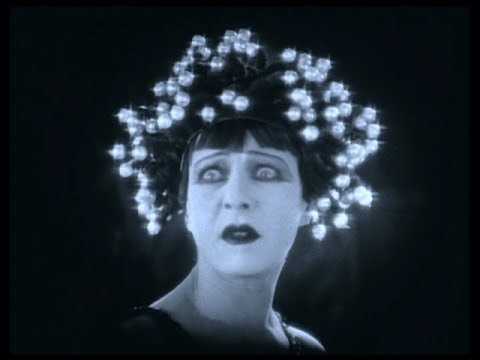
Readers of this blog may notice a preference for the 1940s RKO horror films produced by Val Lewton, who happened to be the nephew of theater and silent film sensation Alla Nazimova. It seems some of the diva’s subversive theatricality and artsy sensibilities found their way into the Lewton-produced films (his novels too), but that, as they say, is another story. In any case as an old movie buff I’d heard of Nazimova and only later learned of her connection to Lewton. In my mind’s eye I envisioned her as a dominating, Amazonian sort physically. Little did I suspect she was a wispy, even dainty figure of a woman. This is certainly the impression one gets in her most famous film role Salomé, in which a 42 year-old Nazimova convincingly impersonates a girl half her age, and even that might be an understatement. How old was Salomé anyway when she performed the most famous striptease in history? Sixteen-ish?

   Anyhow the great Nazimova had the artistic world at her feet for a time in the 1910s and early 1920s [1], until a gradual decline in fortunes both financial and aesthetic [2], largely if unintentionally self-inflicted, rendered her more or less a cultural irrelevance upon her death in 1945 at the relatively youthful (by today’s standards) age of 66. But perhaps there is a happy ending after all, a posthumous comeback, if you like. But more on this later.

   Nazimova was unabashed and unrepentant in her lesbian lifestyle in an age when doing so engendered much risk. But no matter. Her inclinations crept into some of the films she produced, directed and/or starred in, none more so than her aforementioned, ill-fated Art Nouveau magnum opus Salomé [3]. This project has been hailed as a masterpiece by some, scoffed at as an eccentric relic by others, but is possibly most notorious today for being comprised of all gay or bisexual actors, a claim not universally accepted. Artistically the film is most notable for its design qualities, a synthesis of Nouveau, surreal and Deco elements that are still impressive even today a century later. Moreover, the film combines ballet, cinema, grand opera, and, not least of all, melodrama with what might be charitably called less-than-subtle acting.  

  
Salomé may indeed be the first art movie ever. Be that as it may, the silent film it most resembles, for me anyway, and mostly for the design features, is Metropolis [4]. Of course there’s also that wild dance by the evil replicant woman in Metropolis that would not be out of place in Nazimova’s epic. Salomé may also be the first camp film ever, but whether Nazimova set out to create a work of camp is debatable at best, the presence of the predominantly gay cast notwithstanding. Did the concept of camp as a legitimate form of artistic expression even exist in the early 1920s?

   At any rate the conspicuous commercial failure of
Salomé brought to an end Nazimova’s status as a major player in the increasingly corporate controlled (and not so coincidentally, male dominated) film industry in the Twenties. But she wasn’t quite finished yet. She made a few more films and even continued acting well into the sound era, although by this time she was confined to bit parts. Alas many of the early films of “the founding mother of Sapphic Hollywood” and “the most notorious Hollywood lesbian actress of all” are lost to history [5].


   However . . . and in quintessentially theatrical, Nazimova-esque style, the great woman has staged something of a comeback, even though it took nearly seven decades after her death for it to come to fruition. Today there is a Nazimova society, and Nazimova tributes pepper the Internet. The film
Salomé, for all its excesses – perhaps because of its excesses – has been selected for preservation in the United States National Film Registry by the Library of Congress as being "culturally, historically, or aesthetically significant." In 2006, Salomé became available on DVD as a double feature with the avant-garde film Lot in Sodom (1933) by James Sibley Watson and Melville Webber. In 2013 Salomé was screened at the Ojai Music Festival with the Bad Plus performing a live improvised soundtrack. In 2018 Haley Fohr’s experimental score for Salomé was commissioned by Opera North for the Leeds International Festival, and there are even rumblings that it’s time for a mainstream biopic, though Nazimova and mainstream in the same sentence seems a bit of an oxymoron.

[1] For an idea of Nazimova’s cultural and commercial cachet at the time, in 1917 Metro Studios offered Nazimova a 5-year, $13,000 a week contract, an unheard of sum and $3,000 more than Mary Pickford, the world’s biggest movie star, was making. The contract also allowed her director, script, and leading man approval.

[2] In 1918, she moved to Hollywood, where she bought a large Spanish-style house that would later become the Garden of Allah, a hotel and apartment house where a number of Hollywood luminaries would live and where she allegedly hosted wild parties. But Nazimova had little head for business and the hotel quickly lost money. She sold the Garden of Allah in 1930 and concentrated mostly on theater work. When Nazimova moved back to Hollywood in 1938, she rented Villa 24 at the hotel and lived there until she died in 1945, destitute, in poor health, and largely forgotten.

[3] For better or worse, for better I think, 
Salomé is now available in public domain.

[4] There’s more than a hint of, eminently Germanic, myth-invoking rapture 
in Nazimova’s opus maximus, and like Lang’s Metropolis, Salomé's production elements have a retro-futuristic vibe. The Salome as portrayed by Nazimova looks not unlike a cyborg and first cousin to the mechanical Maria of Metropolis.

[5] “founding mother…”: Diana McLellan, The Girls: Sappho Goes to Hollywood, LA Weekly Books, 2000, p. xxiii; “the most notorious lesbian…”: Patricia White, “Nazimova's Veils:
Salomé at the Intersection of Film Histories,” in: A Feminist Reader in Early Cinema, editors, Jennifer Bean and Diane Negri, Duke University Press, 2002, p. 87

Further reading:

William Mann, Behind the Screen: How Gays and Lesbians Shaped Hollywood, 1910-1969, Viking, 2001, pp. 59-62.

Teresa Theophano, Film Actors: Lesbian, 2015. Glbtq archive.


Friday, April 21, 2017

Rosalind!


Thirlwell, Angela. Rosalind: Shakespeare's Immortal Heroine. Pegasus Books, 2017. Summary: Rosalind: Shakespeare's Immortal Heroine is a unique biography exploring the gender bending heroine of As You Like It, seen through the eyes of the artists who have brought her to life.


Perhaps it’s for sentimental reasons that Rosalind is my favorite Shakespearean character and As You Like It my Shakespeare play of choice [1]. By explanation: while attending a conference in Britain in 1985 I was privileged to catch a Royal Shakespeare Society production of As You Like It at Stratford, with Juliet Stevenson as Rosalind, Fiona Shaw as Celia, and the late Alan Rickman, he of the darkly resonant baritone voice, as the melancholic Jaques. I now admit with some shame that, still feeling the effects of jet lag, I nodded off during at least part of the performance. Not that it mattered so much really: I was at the time so untutored in all things Shakespeare that I wasn’t able to fully appreciate the incredible artistry onstage before me.

In any event I’m still not a connoisseur by any means, but, inspired by programs like Shakespeare Uncovered and various cinematic treatments, I’ve acquired a new appreciation and, more important, curiosity about the bard’s works. And that’s a good start. But, good or no, a start is still a start. Today I count myself at most a casual fan; I’ve seen only a handful of plays either on stage, television or film. Yet another humbling reminder of intellectual lacuna on my part.

But to get back to our gender-ambiguous heroine: Rosalind is of course a rebel, a poet and wit. Accordingly she’s the woman who can’t stop talking: she has more lines than any other Shakespearean female character, outpacing even such luminaries as Juliet and Beatrice. Her message of freedom and all the many-faceted textures, shadings, and indeed contradictions, a woman – or man, for that matter – can potentially, and gloriously, possess resonates with Twenty-first century sensibilities. But, as Thirwell points out in her ever vigilant survey, Rosalind has spoken to audiences of other eras with equal vigor. Still, if a poll were taken today of the Shakespeare buff’s favorite female character, I suspect Rosalind might well take the palm, with Beatrice a close second.

Whatever the case, Thirwell’s superlative opus, a self-described ‘biography,’ is in reality a blend of perspicacious literary critique along with her personal recollections of, and sometimes interviews with, the great Rosalinds who have graced the stage – and screen [2]. There’s also a goodly amount of cultural and political history covered, along with the usual suspects that bespeak a scholarly treatment: index, source notes, extensive bibliography, etc. Thus the book is not necessarily an easy or fast read. On the other hand for the susceptible among us it’s relatively accessible, further buttressed by the many well-chosen photos. In sum, Rosalind is a must read for the true Shakespeare fan and an inspiration for the novice.

Further reading: Mark Anderson, “Shakespeare” by another name: the life of Edward de Vere, Earl of Oxford, the man who was Shakespeare, Gotham, 2005; Joseph Sobran, Alias Shakespeare, Free Press, 1997

[1] By way of what’s called full disclosure these days I fess up that I fall in with the Oxford Theory crowd on the Shakespearean authorship question, i.e. that the immortal works attributed to the man from Stratford were actually ghost written by someone else, most likely Edward De Vere, 17th Earl of Oxford. Not that I’m totally and uncritically convinced, but I find the balance of evidence, to coin a legalistic metaphor, persuasive. But … however compelling the evidence may be, it’s unlikely that the Oxford theory will ever win the argument and be accepted by the general public, much less the academic cognoscenti, within our lifetimes anyway. Orthodoxy and tradition die hard, and wholesale re-writings of history don't happen overnight.
In any event, I offer this somewhat long-winded explanation in footnote form as an apologia for my current sympathies as to the authorship question, but in present post I opt for using ‘Shakespeare’ for clarity and consistency.
[2] Update: recently I was fortunate to catch on tv the 1936 film version of As You Like It, directed by Paul Czinner and starring Laurence Olivier as Orlando and Elisabeth Bergner as Rosalind. I’d never seen the film before and while the production values are creaky by today’s standards, this interpretation veritably explodes with energy via its sprightly direction and über-British cast. Miss Bergner in particular shines as Rosalind in her memorable take on the role. The supporting cast does yeoman work and everyone seems to be having a rousing good time in this, one of the bard’s most fanciful and playful creations.

Thursday, March 2, 2017

White Hot: The Mysterious Murder of Thelma Todd (1991)


I just had the happy fortune to catch White Hot on the Escape TV channel and enjoyed it very much. White Hot is of course a made-for-tv movie version, ca. early Nineties, of 1930s actress Thelma Todd’s mysterious death, and thus might be dubbed a proverbial guilty pleasure. But guilty or no, the film has much to savor.

While the basic structure of White Hot – flashbacks and reminiscences seen through the eyes of friends and associates – recalls, of all films, Citizen Kane, the movie nonetheless is a well-made product quintessentially typical of its genre and era: high gloss, gauzy, and cattily gossipy. But White Hot manages to rise above its aesthetic pedigree by virtue of its excellent cast and especially the loving recreation of the Thirties Hollywood milieu.

It’s true Loni Anderson is a tad old for the role, and her wardrobe and hair style are more Jean Harlow than the real Thelma Todd. But no matter. Ms. Anderson does a great job in portraying, with exceptional sensitivity, the brio and energy of an appealing yet complex personality – by turns confident, insecure, streetwise and naïve.

Also worth a mention is Scott Paulin as a Philip Marlowe-esque investigator for the district attorney’s office, and Maryedith Burrell as actress and Thelma’s friend Patsy Kelly. Maybe not a masterpiece, White Hot is still lots of fun and especially a treat for old movie buffs, in its way little short of irresistible. And besides which, the whole business is just so darned mysterious. There’s nothing like an unsolved, and, in this case, probably unsolvable, mystery.

Further reading: Michelle Morgan, Ice Cream Blonde: the Whirlwind Life and Mysterious Death of Screwball Comedienne Thelma Todd, Chicago Review Press, 2015.

Thursday, August 5, 2010

Las reinas de las rumberas


Las reinas del trópico: María Antonieta Pons, Meche Barba, Amalia Aguilar, Ninón Sevilla, Rosa Carmina, by Fernando Muñoz Castillo. [México, D.F.] : Grupo Azabache, 1993. "Se termino de imprimir en julio de 1993 en Offset 70, S.A. de C.V., Victor Hugo 99, Mexico,03300, D.F."

Las reinas del trópico is a loving pictorial tribute to the five Latina actresses* in the book's subtitle, focusing on their spicy dance numbers in the rumberas (aka cabaretera) cinematic genre popular in the 1940s and 1950s. In the context of cine negro the book is also noteworthy for its many tasty and very noirish photos of the (non-cabaret) scenes from individual films. See also : Rumberas cubanas, reinas en el cine.


*
They all attained fame in Mexican films but only one of them (Meche Barba) was actually of Mexican descent
.