Errol Flynn creeped her out, Elizabeth Taylor refused to be photographed alongside her, she thought up the name ‘Marilyn Monroe’ [1], but most of all wanted to make sure that Edmund O’Brien was Dead on Arrival. Born Loretta Mary Luiz in Honolulu, of Portuguese-Hawaiian-Australian extract, Laurette Luez was one of the most promising of a handful of can’t-miss starlets of the post-WWII era. Her breakthrough year seemed to be 1950, when she appeared in two good films, D.O.A. and Kim. In the former her femme fatale credentials – beauty, brains, and lots of attitude – were showcased to best advantage, but cruelly it was the harem girl role in Kim that would foreshadow her career in the 1950s, when in a rapid and inexplicable descent into B movie purgatory (most infamously in Prehistoric Women), she was invariably typecast as island girls, exotic temptresses and jungle primitives. A typical role was that of the slave-girl Karamaneh in the 1956 TV series The Adventures of Dr. Fu Manchu. By the end of the decade her career was essentially over [2]. Ironically, her last film, Ballad of a Gunfighter (1964), was actually pretty good.
What was the cause of her conspicuous cinematic non-success? Bad management, infelicitous timing, competition? Or perhaps she really didn’t have the acting talent. A more plausible explanation is that the film studios simply felt that, by the standards of the strait-laced 1950s, her dusky looks were a little too ethnic for full-fledged leading lady status. This was the post-Carmen Miranda era in Hollywood when Latino actors were very much out of fashion. In any case, in 1965 she left movies altogether to devote herself to being a full-time wife and mother, and film star Laurette Luez faded into historical obscurity. In 1999 she died at the age of 71. But through a resurgence in popularity of both film noir and 1950s camp, her star has risen once again as is witnessed by numerous affectionate blog tributes and a plethora of Web images, bringing to her a certain amount of posthumous recognition and appreciation that eluded her in her own lifetime.
[1] The MM story is quite possibly more urban legend than fact. As direct information is scarce – and others have made the claim as well – we’ll probably never know for sure.
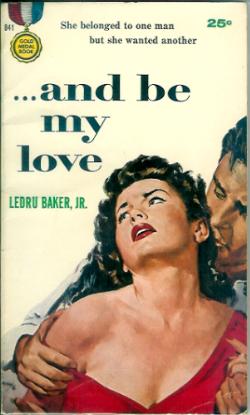
[2] To be sure, her likeness wasn’t exactly absent in her heyday years in the 1950s. As if in compensation for her disappointment in the film industry, she was much in demand as a model and for a time seemed to be a ubiquitous presence on the covers of men’s magazines. Her photogenic features even seemed to inspire pulp fiction cover art.
 |
| D.O.A. (1950) |