Showing posts with label 1970s movies. Show all posts

Saturday, September 21, 2024

any dream was better than no dream ... The Day of the Locust (1975)


   The Day of the Locust [DVD]. Hollywood, Calif.: Paramount Pictures, 2004. John Schlesinger, director. Based on the novel by Nathanael West. Director of photography, Conrad Hall; music, John Barry; editor, Jim Clark. Summary: a naive young set designer seeks work in Tinseltown and falls in love with an aspiring actress who lives with her alcoholic father, a former vaudevillian entertainer turned snake oil salesman. Originally produced as a motion picture in 1975. Performers: Karen Black, Burgess Meredith, Donald Sutherland, William Atherton, Richard A. Dysart, Geraldine Page, Paul Stewart.


     John Schlesinger’s bitterly sardonic take on Nathanael West’s blistering novel hasn’t lost any of its bite even today, a half century later. Alas, like West’s novel, the film version languishes under the radar, and indeed a reconsideration of both is long overdue [1]. Day of the Locust is in the tradition of such gloves-off portrayals of the dark side of the movie business the likes of Sunset Boulevard and The Bad and the Beautiful, just more so. At 144 minutes Locust is a tad long with many weird detours, dead ends and lost weekends, but director Schlesinger keeps things moving apace so well that we don’t really notice.    

     First, a comment on the look of the movie. Locust is at heart a dark fairy tale – some would say a horror film – that takes place (nearly) nine decades ago. Yes, it’s still the Depression [2]. Thus it deserves a strange look, and gets it, filmed through a mist-like gauzy overlay that actually adds to the film’s mystique. Moreover, the story is rendered through a prism of mid 1970s cinéma vérité aesthetic, Seventies style slice-of-life chic if you will, but in this case a glamorous, if falsely so, slice.

     For me the centerpiece of the film, figuratively and literally – it takes place about half way through – is the visit to Big Sister’s revival. It breezes by much too quickly and ostensibly doesn’t have a lot to do with the Hollywood milieu, then again maybe it does. The revival meeting's schtick is really a massive production number that mirrors the hype and glitz of Hollywood productions. Entertainment and show business by any other name, while the ka-ching of cash registers and the counting of money provide a realpolitik if admittedly heavy-handed obbligato [3]. Moreover, the religious frenzy at the revival parallels the later, gaudy opening night extravaganza, complete with de rigueur searchlights, of DeMille’s The Buccaneer. In the latter the potential for violence releases itself in an orgy of destruction and rampant savagery that still shocks even today in our supposedly seen-and-heard-it-all world. Perhaps the gala opening is a metaphor for American society itself in the Thirties, but it actually comes too close for comfort in our supposedly more enlightened 21st Century: the fans who jostle, shove and gouge for a glimpse of the god- and goddess-like stars are selfish, materialistic sorts, obsessed with the glamor of the illusion, or is it the illusion of glamour? Either way, the various losers, hangers-on, and assorted white trash that do their best to crash the première mirror the locust-like little people that litter the film and which Tod keeps bumping into. In Nathanael West’s vision even those on the inside or the fringes will be pulled down into the Hadean cauldron with the rest of us ordinary mortals. And seemingly benign characters such as Hackett, Claude Estee and Helverston, because of their very casual cruelty and aloofness to the industry's savage indifference to the little guy, are more loathsome than the various abrasive grotesques that flit in and out.
    By the way, Geraldine Page is wonderful as the evangelist with pizazz, the aforementioned Big Sister, one of those offbeat characters she does so well. The role actually anticipates – by nearly a half century – similar characters in the television miniseries Penny Dreadful: City of Angels and Perry Mason (they just love including those Thirties-era spiritual leaders as secondary characters in Hollywood period pieces). As the fellow said, the end times may be upon us, but they can be very entertaining. 

     But in a movie of myriad disturbing images and scenes, for me the most brutal and heartless of the lot is the impromptu cockfight which looks all the world like the real thing. Truly a heartbreaking result as a bloodied animal lies on the floor, probably mortally wounded. Perhaps appropriately, after the cockfight the spectators enjoy a dinner party that transitions to a kind of PG-rated bacchanal, with Faye as the main attraction.
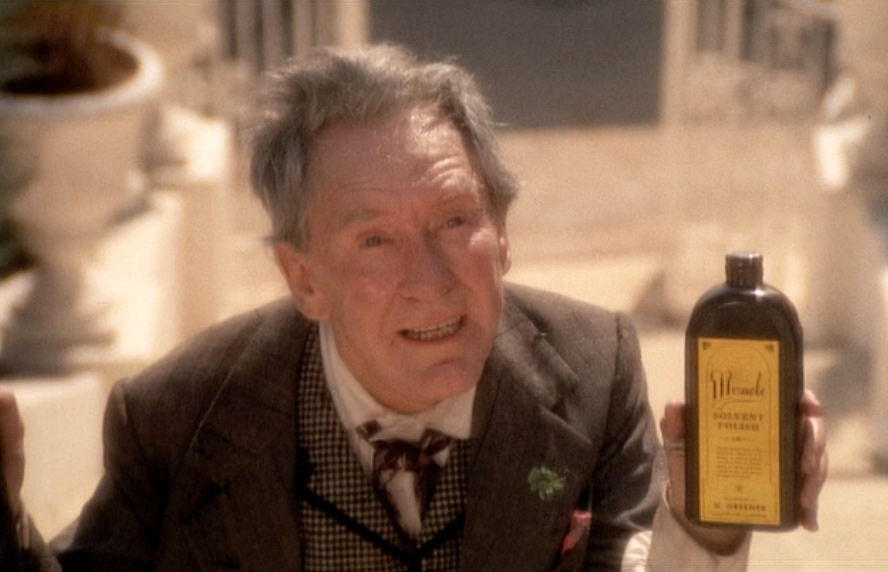
"magic is what I'm selling"
     But getting back to humans, the various losers, grotesques and other outsiders who populate Locust, waiting at the stop sign of life for their one big break, are actually depicted in one of Hackett’s tableau as three chalk faced folks wait on a bench at a bus stop. West himself had a love-hate relationship with the film industry that mirrored his own contradictory nature: he was both a romantic and cynic; a plagiarist who was also a gifted, original writer; a savage critic of the Hollywood dream who never quite gave up on the dream.

     In any case, West knew of what he spoke: he toiled as a writer of B scripts and like Locust’s hero Tod Hackett lived in dive hotels and run-down apartments. He knew all too well the labyrinthine mechanics of the movie business and the frustrations of the extras, bit players, assistant directors, and, lowest of all, writers. Tod Hackett, Locust’s hero and arguably a West self-portrait, is one of the few haves in a world of have-nots. A rather high-minded artiste just beginning his career as a set designer, he struggles to come to terms with going Hollywood, and appropriately his opus maximus, created on the sly, is a painterly tableau titled “The Burning of Los Angeles.”
     Along the way Hackett encounters various seedy and colorful characters, among them an actress neighbor who catches his eye. He also crosses paths with the actress’s father, a washed-up vaudevillian turned snake oil salesman, as well as a certain Homer Simpson, onetime accountant convalescing in California’s balmy climate. Monosyllabic cowboys, amorous Mexicans, and a curmudgeonly midget named Abe Kusich add to the mix. Not many of the characters who populate Locust are likable, not even the ostensible good guy Tod. But that was the idea: West wanted to portray the desperate low-lifes and perpetual wannabes existing under the façade of Hollywood glitz and glamour. Unpalatable the little people may be, we still feel sympathy for them and this is part of West’s genius.

     All these elements are beautifully realized by the film, especially the performances, which are generally over-the-top, and rightly so. This makes them so on the money because the exaggerated deliveries are in their way genuine, masking as they do the desperation and disappointment the characters feel. Meriting a singling out are Karen Black in the performance of a career as the vacuous Faye Greener, Burgess Meredith as Faye’s alcoholic father, Natalie Schafer as brothel madam Audrey (a long way from hoity-toity Mrs. Howell), and the great Billy Barty as the obstreperous dwarf Abe Kusich. More sedate are a bland William Atherton as our nominal hero Tod Hackett and Richard Dysart as a cold fish Hollywood executive with a taste for softcore porn and high class call girls. Good performances, true, by Atherton and Dysart but as haves in a world of have nots their characters can afford to be more guarded and reserved. Contrary to the critical and fan rave reviews for Donald Sutherland, I wasn’t taken with his zombie-like interpretation of the Homer Simpson.

     My only complaint is that the Paramount DVD has zero bonus features, a major oversight considering the film’s literary, historic and aesthetic connections. There seems to be a ‘limited edition’ blu-ray, which I understand has a generous sampling of supplements. And this is only just. Day of the Locust is a forgotten masterpiece that deserves a presentation and packaging worthy of its stature.   

   [1] To be technically correct, academics and cultists have long been familiar with West’s magnum opus, but among the general public West doesn’t have the high profile of the likes of Hammett, Chandler, and Cain.  

   [2] I may have missed it but I don’t recall any overt references to the year in which Locust is taking place. But from all the clues we’re given I place it to be ca. 1938.

   [3] The show biz connection couldn't be made plainer when Harry hallucinates that his on-stage 'cure' is another performance and the ecstatic faithful are his audience. 'I stole the show,' he later reminisces.


Saturday, April 1, 2023

"this is my happening ..." : Beyond the Valley of the Dolls (1970)


    Beyond the Valley of the Dolls (Motion picture); a Russ Meyer production; screenplay by Roger Ebert; story by Roger Ebert and Russ Meyer; produced and directed by Russ Meyer; music, Stu Phillips; director of photography, Fred J. Koenekamp; art directors, Jack Martin Smith, Arthur Lonergan; editors, Dann Cahn, Dick Wormell. Produced and released by Twentieth Century-Fox Film Corporation. Two-DVD special edition; widescreen. New York, N.Y.: The Criterion Collection, 2016. Originally released as a motion picture in 1970.

    "The film ... is not a sequel to Valley of the Dolls. It does ... deal with the oft-times nightmare world of show business in a different time and place."  
    Performers: Dolly Read, Cynthia Myers, Marcia McBroom, John LaZar, Michael Blodgett, David Gurian, Edy Williams, Erica Gavin, Phyllis Davis, Henry Rowland, Harrison Page, Duncan McLeod, Jim Iglehart, Haji, Charles Napier, and the Strawberry Alarm Clock.
    Summary: With a studio budget at his command and a satirical screenplay by Roger Ebert, nudie cutie director Russ Meyer told the story of three young starlets seeking glory in a Bacchanalian Hollywood, all rendered in quintessentially flamboyant Sixties style with the director's usual libidinal excess and irreverence. 


    My first Russ Meyer movie: I remember it well. No, it wasn’t Beyond the Valley of the Dolls, but no worries, we’ll get to it. Anyhow, being a fresh-faced first semester freshman at our small-town university back in the day, some friends and I thought it would be fun – and definitely naughty – to go see such forbidden fruit as a nudie movie. The film was Finders Keepers, Lovers Weepers [1], apparently not one of Meyer’s more memorable efforts but immensely entertaining, at least I thought so. The film played in a mainstream theater on the main street in town, as did the next film in the Meyer pantheon, the much more famous, and better, Vixen, starring Erica Gavin. Of course I also made it a point to check out Vixen. Aside: at about this time I also took in Gone with the Wind, maybe at the same theater (I hope so; the irony appeals to me). I’d never seen GWTW before and it was then in the midst of revival screenings. Impressive it was, certainly for its era, but the Meyer flicks made more of an impression. Today, at the risk of being heretical, I’d say Beyond the Valley of the Dolls is straight up a better movie than Gone with the Wind. But I begin to digress. In any event, when I first heard that the title of Meyer’s then-newest, ultimate opus was going to be Beyond the Valley of the Dolls, I thought, you gotta’ be kidding me. Curiously, the specifics of my catching Dolls are much less precise in the memory (the release date was July 1970). The venue may have been a drive-in, maybe a theater. The explanation must be that so much had happened in the world and in my own life in the intervening couple of years that it just didn’t register as much. Even the content of the movie didn’t stand out in the memory, and thus I can only recall a few details from that initial viewing: Ronnie Z-Man’s big reveal, Michael Blodgett's leopard spotted trunks, the beheading, Edy Williams, that’s about all. I’d even forgotten that it was (sort of) a musical.

     Now, a half century later, I just caught Dolls again, and call it nostalgia, sentiment, whatever, I absolutely loved it, so much so that I saw the film two times, four actually if you count the two commentary tracks. What they say about the film is true: it ages like fine wine. In a word, time has been kind to Beyond the Valley of the Dolls. Perhaps the explanation is its very obviousness and lack of guile. For all the nudity, colorful language, sexual situations, and occasional shocking violence, Dolls has an innocence, warmth and optimism, which, along with its high gloss look, is still appealing and endearing, thus allowing the film to transcend its, frequently sordid, subject matter.
Meyer is to be further commended because he, like my own parents, was of the prior, WW2 generation that, to say the least, simply didn’t relate to the Summer of Love, anti-war protests, the drug scene, rock music, and everything else going on in the 1960s, and were more often than not mystified, even revolted, by it. Thus it's to Meyer’s credit, albeit with script writer Ebert’s vital contribution, that he got it right on so many of the cultural references of ca. 1969 [2], even granting it’s all done in the context of satire.

       As for Dolls itself, the principals give it their all, and they actually add, shall we say, authenticity to the mix in that most aren’t professional actors, but nonetheless do quite well in their roles. Their exuberance, and a lot of the innocence, carries over onto the DVD commentary by five of the actors (Dolly Read, Cynthia Myers, Harrison Page, John LaZar, and Erica Gavin), who are having a great time reminiscing and adding their own little touches of history and trivia. By the way Roger Ebert’s more cerebral commentary track is equally engaging, providing much film industry detail and lots on director Meyer.

    Two minor criticisms of Dolls: there may be one song sequence too many, and the final pious epilogue seems out of place in such a seat-of-the-pants, wild ride production. But why bother with such (relative) trifles amongst the manifest mountain of riches.

    Beyond the Valley of the Dolls will always, I suppose, polarize fans (and non-fans), a movie that people either love or hate, consider it a kind of masterpiece or a candidate for the worst movies of all time hall of fame. Well, for better or worse, I fall into the love category. I don’t know if I’d anoint it a masterpiece, though it may (or may not) be Meyer’s masterpiece. Many would go with Faster, Pussycat! Kill! Kill!, and I tend to agree. At minimum, Dolls is certainly Meyer's most polished, highest gloss production, not so coincidentally done with all the resources of a big studio behind him.  

     And whatever one might think of the film’s desultory, Felliniesque content, from a purely technical standpoint it’s absolutely first rate, and it just plain looks great (sounds great, too) in Criterion’s all-the-trimmings 2-DVD release [3]. The film then is sui generis; nothing quite like it has ever been put on the screen, before or since, and it’s been creeping up in critical esteem over the years [4].
   More important, the film is an eloquent valedictory coda to all that was right, and wrong, with the Sixties, as well as a meditation on the energetic recklessness of youth and the joy of living in that wild, wonderful, sometimes irresponsible time, gone forever it would seem. But not so fast, my friend. Even today, a half century and change later, as one of seventy something years, I nonetheless sense a sliver of the spirit of Dolls that remains in the nether regions of the psyche. In our very different world today, Dolls's message of compassion, tolerance, freedom, social justice, inclusion, pacifism, and respect for the environment - and each other - still resonates. In its outrageously wacky way, Beyond the Valley of the Dolls is still modern, more than a little wise, and, perhaps most important, it says something to us about, life, love and the human condition that’s both timely and timeless.

style
****
substance
****


    [1] There’s one scene in Finders Keepers in which a guy is having a steamy phone conversation with the object of his desire as Chopin wafts in the background. Pretty heady stuff – a touch of class in a skin flick.

    [2] As one who lived during the anything goes era of the late Sixties, in my opinion Dolls is not that exaggerated in the various tableaux depicted and the use of hippy/youth slang. To wit: your humble writerly servant indeed attended some of the - wild or otherwise - counter-culture parties and 'happenings' of the era (some even freaked me out). More to the point, the film actually captures the zeitgeist pretty well, however flawed, or excessive, some of the details might be. In a word, it got the spirit right.

   [3] The Criterion version includes a bevy of special features, including the above-mentioned commentary tracks; the making-of short, "Above, Beneath and Beyond the Valley: The Making of a Musical-Horror-Sex-Comedy;" episode from 1988 of The 'Incredibly Strange Film Show' on director Russ Meyer, and others. But my favorites are the extended interview with John Waters in which he talks about his association with Meyer and offers a brief overview of Meyer's career; and the very sweet "Casey & Roxanne: The Love Scene", in which Cynthia Myers and Erica Gavin look back three and a half decades later at their lesbian scenes in the film.
     Aside: I always preferred that actors sing their own songs, and I labored under the illusion that the women in the rock group actually sang their own material. Alas, I later found out to the contrary, though the lip synching is pretty darn good. In any case apparently the women just didn’t have the voices to convincingly put over the tunes.

      [4] One measure of Dolls’ growing critical acceptance is that it received two votes in the 2012 BFI/Sight & Sound poll of the greatest movies of all time.
* While two votes might qualify as a low-level honorable mention at best, it’s better than no acknowledgement at all. The film is also beginning to show up on directors’ and cineaste’s best movies of all time lists.
    Aside: it's curious that the fiftieth anniversary of Dolls in 2020 went largely unheralded. Searches online and elsewhere yielded a paucity of results as to think pieces or public events. Part of the explanation of the lack of Golden Anniversary gala events may have been due to bad timing: this was the first year of the Covid virus.  


   * Sight & Sound/BFI has a relatively simple and, at least in theory, equitable method of ranking the films. For the 2022 poll, each critic of the 1,639 total critics polled was asked to submit his/her own top ten choices. Each film that gets a vote gets a point, the points are tallied at the end and the films ranked by the number of points.
     By the way in case one wonders why I reference 2012 in fn4 above and not 2022, the explanation is that, as of the writing of this post, I’ve been unable to locate a comprehensive list of films that received at least one vote in the 2022 poll.
     [Update, 13 May 2024: While it took some digging, I was able to verify that in the 2022 poll Dolls received four votes, again a low level honorable mention of the four thousand-odd titles that received at least one vote. It should be mentioned that the information I found combined both the critics' and directors' polls, thus if we fudge the numbers four votes might be considered roughly analogous to the two votes it received last time around (2012). Also of interest is that two other Meyer productions, Beneath the Valley of the Ultra Vixens (1 vote) and the above-mentioned 
Faster, Pussycat! Kill! Kill! (4 votes) were listed in the 2022 poll, all of which is signaling a measure of respectability for Meyer as a director of substance.] 


Friday, February 19, 2016

There's something about a paranoid thriller : Dollars (1971)


Dollars [DVD]. Columbua Pictures; produced by M.J. Frankovich; written and directed by Richard Brooks. Columbia Pictures: Sony Pictures Home Entertainment,[2008]. Originally released as a motion picture in 1971. Music, Quincy Jones. Performers: Warren Beatty, Goldie Hawn, Gert Frobe. Summary: A call girl teams up with a security expert to steal money from the safety deposit boxes of three crooks.

style ***1/2
substance ***


“Every big crime’s supposed to say something about the time we live in”


I’d never even heard of Dollars till I caught it the other day on getTV and found it to be something of an undiscovered gem: not quite a masterpiece but a darn good, eminently entertaining yarn, consummately executed by those in front of and behind the camera.

While I admit it’s a stretch to place this in the paranoid thriller category, it has enough similarities as to both style, content, and era to - just barely - merit inclusion in this rather artificially created genre. To wit, there are mysterious, alternatingly menacing and comic, bad guys who drift in and out of the story. One who has a penchant for wearing sunglasses in particular projects an oily malevolence.

Dollars has a Euro style, you-are-there feel to it, a certain urban grittiness, if you like, punctuated by the mod Quincy Jones score which is complemented by tunes sung by Little Richard and Roberta Flack. It’s all a jangly, cinema-verité style, to be sure, which may not be to all tastes but impossible to ignore.

The film - a sort of  synthesis of Oceans 11, Day of the Jackal, and a James Bond flick - is very much of its time, but also prescient, by several decades, in its cheeky sendup of Big Money, the black market, and American economic imperialism (it was set and filmed in a most unappetizing Hamburg, the same city that provided the backdrop for the much more recent, and superior, A Most Wanted Man, with which it has certain similarities).

Writer-director Richard Brooks is in top form and keeps things moving forward with a lively but steady hand. Our nominal stars Beatty and Hawn have great chemistry but the quirky supporting cast which features familiar faces but not a lot of familiar names is if anything even more delicious. We even have Mr. Goldfinger himself Gert Fröbe, who plays a well-intended but rather slow witted bank executive. My only criticism of the film is the edge-of-the-ledge chase finale, which, albeit skillfully done, goes on a bit too long.

Time has been kind to Dollars:  while some of its atmospherics show signs of age, its message and basic truths are right on the money even today.