Showing posts with label Los Angeles. Show all posts

Saturday, September 21, 2024

any dream was better than no dream ... The Day of the Locust (1975)


   The Day of the Locust [DVD]. Hollywood, Calif.: Paramount Pictures, 2004. John Schlesinger, director. Based on the novel by Nathanael West. Director of photography, Conrad Hall; music, John Barry; editor, Jim Clark. Summary: a naive young set designer seeks work in Tinseltown and falls in love with an aspiring actress who lives with her alcoholic father, a former vaudevillian entertainer turned snake oil salesman. Originally produced as a motion picture in 1975. Performers: Karen Black, Burgess Meredith, Donald Sutherland, William Atherton, Richard A. Dysart, Geraldine Page, Paul Stewart.


     John Schlesinger’s bitterly sardonic take on Nathanael West’s blistering novel hasn’t lost any of its bite even today, a half century later. Alas, like West’s novel, the film version languishes under the radar, and indeed a reconsideration of both is long overdue [1]. Day of the Locust is in the tradition of such gloves-off portrayals of the dark side of the movie business the likes of Sunset Boulevard and The Bad and the Beautiful, just more so. At 144 minutes Locust is a tad long with many weird detours, dead ends and lost weekends, but director Schlesinger keeps things moving apace so well that we don’t really notice.    

     First, a comment on the look of the movie. Locust is at heart a dark fairy tale – some would say a horror film – that takes place (nearly) nine decades ago. Yes, it’s still the Depression [2]. Thus it deserves a strange look, and gets it, filmed through a mist-like gauzy overlay that actually adds to the film’s mystique. Moreover, the story is rendered through a prism of mid 1970s cinéma vérité aesthetic, Seventies style slice-of-life chic if you will, but in this case a glamorous, if falsely so, slice.

     For me the centerpiece of the film, figuratively and literally – it takes place about half way through – is the visit to Big Sister’s revival. It breezes by much too quickly and ostensibly doesn’t have a lot to do with the Hollywood milieu, then again maybe it does. The revival meeting's schtick is really a massive production number that mirrors the hype and glitz of Hollywood productions. Entertainment and show business by any other name, while the ka-ching of cash registers and the counting of money provide a realpolitik if admittedly heavy-handed obbligato [3]. Moreover, the religious frenzy at the revival parallels the later, gaudy opening night extravaganza, complete with de rigueur searchlights, of DeMille’s The Buccaneer. In the latter the potential for violence releases itself in an orgy of destruction and rampant savagery that still shocks even today in our supposedly seen-and-heard-it-all world. Perhaps the gala opening is a metaphor for American society itself in the Thirties, but it actually comes too close for comfort in our supposedly more enlightened 21st Century: the fans who jostle, shove and gouge for a glimpse of the god- and goddess-like stars are selfish, materialistic sorts, obsessed with the glamor of the illusion, or is it the illusion of glamour? Either way, the various losers, hangers-on, and assorted white trash that do their best to crash the première mirror the locust-like little people that litter the film and which Tod keeps bumping into. In Nathanael West’s vision even those on the inside or the fringes will be pulled down into the Hadean cauldron with the rest of us ordinary mortals. And seemingly benign characters such as Hackett, Claude Estee and Helverston, because of their very casual cruelty and aloofness to the industry's savage indifference to the little guy, are more loathsome than the various abrasive grotesques that flit in and out.
    By the way, Geraldine Page is wonderful as the evangelist with pizazz, the aforementioned Big Sister, one of those offbeat characters she does so well. The role actually anticipates – by nearly a half century – similar characters in the television miniseries Penny Dreadful: City of Angels and Perry Mason (they just love including those Thirties-era spiritual leaders as secondary characters in Hollywood period pieces). As the fellow said, the end times may be upon us, but they can be very entertaining. 

     But in a movie of myriad disturbing images and scenes, for me the most brutal and heartless of the lot is the impromptu cockfight which looks all the world like the real thing. Truly a heartbreaking result as a bloodied animal lies on the floor, probably mortally wounded. Perhaps appropriately, after the cockfight the spectators enjoy a dinner party that transitions to a kind of PG-rated bacchanal, with Faye as the main attraction.
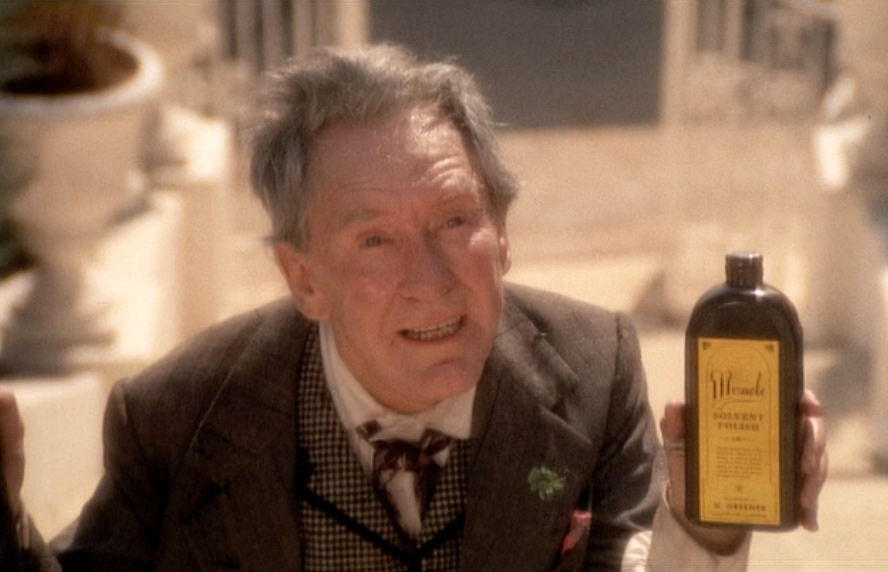
"magic is what I'm selling"
     But getting back to humans, the various losers, grotesques and other outsiders who populate Locust, waiting at the stop sign of life for their one big break, are actually depicted in one of Hackett’s tableau as three chalk faced folks wait on a bench at a bus stop. West himself had a love-hate relationship with the film industry that mirrored his own contradictory nature: he was both a romantic and cynic; a plagiarist who was also a gifted, original writer; a savage critic of the Hollywood dream who never quite gave up on the dream.

     In any case, West knew of what he spoke: he toiled as a writer of B scripts and like Locust’s hero Tod Hackett lived in dive hotels and run-down apartments. He knew all too well the labyrinthine mechanics of the movie business and the frustrations of the extras, bit players, assistant directors, and, lowest of all, writers. Tod Hackett, Locust’s hero and arguably a West self-portrait, is one of the few haves in a world of have-nots. A rather high-minded artiste just beginning his career as a set designer, he struggles to come to terms with going Hollywood, and appropriately his opus maximus, created on the sly, is a painterly tableau titled “The Burning of Los Angeles.”
     Along the way Hackett encounters various seedy and colorful characters, among them an actress neighbor who catches his eye. He also crosses paths with the actress’s father, a washed-up vaudevillian turned snake oil salesman, as well as a certain Homer Simpson, onetime accountant convalescing in California’s balmy climate. Monosyllabic cowboys, amorous Mexicans, and a curmudgeonly midget named Abe Kusich add to the mix. Not many of the characters who populate Locust are likable, not even the ostensible good guy Tod. But that was the idea: West wanted to portray the desperate low-lifes and perpetual wannabes existing under the façade of Hollywood glitz and glamour. Unpalatable the little people may be, we still feel sympathy for them and this is part of West’s genius.

     All these elements are beautifully realized by the film, especially the performances, which are generally over-the-top, and rightly so. This makes them so on the money because the exaggerated deliveries are in their way genuine, masking as they do the desperation and disappointment the characters feel. Meriting a singling out are Karen Black in the performance of a career as the vacuous Faye Greener, Burgess Meredith as Faye’s alcoholic father, Natalie Schafer as brothel madam Audrey (a long way from hoity-toity Mrs. Howell), and the great Billy Barty as the obstreperous dwarf Abe Kusich. More sedate are a bland William Atherton as our nominal hero Tod Hackett and Richard Dysart as a cold fish Hollywood executive with a taste for softcore porn and high class call girls. Good performances, true, by Atherton and Dysart but as haves in a world of have nots their characters can afford to be more guarded and reserved. Contrary to the critical and fan rave reviews for Donald Sutherland, I wasn’t taken with his zombie-like interpretation of the Homer Simpson.

     My only complaint is that the Paramount DVD has zero bonus features, a major oversight considering the film’s literary, historic and aesthetic connections. There seems to be a ‘limited edition’ blu-ray, which I understand has a generous sampling of supplements. And this is only just. Day of the Locust is a forgotten masterpiece that deserves a presentation and packaging worthy of its stature.   

   [1] To be technically correct, academics and cultists have long been familiar with West’s magnum opus, but among the general public West doesn’t have the high profile of the likes of Hammett, Chandler, and Cain.  

   [2] I may have missed it but I don’t recall any overt references to the year in which Locust is taking place. But from all the clues we’re given I place it to be ca. 1938.

   [3] The show biz connection couldn't be made plainer when Harry hallucinates that his on-stage 'cure' is another performance and the ecstatic faithful are his audience. 'I stole the show,' he later reminisces.


Saturday, September 30, 2023

"no hay banda": Mulholland Drive (2001)

    Mulholland Drive. David Lynch (director, screenwriter), Alain Sarde (producer), Pierre Edelman (producer), Mary Sweeney (producer, editor), Neal Edelstein (producer), Michael Polaire (producer), Tony Krantz (producer), Angelo Badalamenti (composer). Performers: Justin Theroux, Naomi Watts, Laura Harring, Ann Miller, Dan Hedaya, Mark Pellegrino. DVD Video, English, 2015. [Director-approved two-DVD special edition]. The Criterion Collection, [New York, N.Y.], 2015. #779. Originally produced as a motion picture in 2001.
    Summary: Betty Elms has only just arrived in Hollywood to become a movie star when she meets an enigmatic brunette with amnesia. Meanwhile, as the two set off to solve the second woman's identity, filmmaker Adam Kesher runs into ominous trouble while casting his latest project.
    Special features: Disc 2: Interviews: David Lynch and Naomi Watts (27 min.); Laura Harring, Johanna Ray, Justin Theroux, and Naomi Watts (36 min.); Angelo Badalamenti (20 min.); Peter Deming and Jack Fisk (22 min.); deleted scene; on-set footage (25 min.); trailer. Includes a booklet featuring an interview with Lynch from filmmaker and writer Chris Rodley's 2005 edition of the book "Lynch on Lynch."


Sunset Blvd. meets the Twilight Zone …

     I’m still not sure whether I think Mulholland Drive is the best movie I’ve ever seen, or the worst, as I’ve reacted both ways at different times. No surprise, given the polarized opinions of fans, devotees and (anti)devotees. For the moment I’ll split the difference and opine that Mulholland Dr. is a tad overrated, but still pretty darn good. And even if repeated viewings bring me no closer to understanding the true meaning or correct interpretation, I do confess that I rather enjoy the film more each time I see it.
     Nonlinear story lines in movies have been around a long time [1], and perhaps the most successful, in my opinion, is Last Year at Marienbad. For me Marienbad had a kind of inner logic and consistency – admittedly elusive and difficult to articulate – that nonetheless place it among the truly great. The other movie Mulholland reminds me of, strangely enough, is the offbeat crypto-noir Dementia (aka Daughter of Horror), which also has a dreamscape tableaux, shifting reality/fantasy, off-kilter narrative, femme fatale in peril, nasty villains, and most of all, atmosphere to burn [2].
     But what is MD about? Whatever else it may be, MD for me is at heart a meditation on the dark side of Hollywood, served up full-on phantasmagoric. In a word, MD makes The Big Sleep look like a straightforward crime story and Sunset Blvd. a Hallmark Hall of Fame weepie (coincidentally, both Big Sleep and Sunset Blvd. explore the seamy underbelly of Los Angeles culture and the movie business, but using a different cinematic language).
     Getting back to MD, the first more or less two-thirds of the film seduces us into believing the story is a conventional mystery, albeit with quirky touches, but a mystery that will ultimately give us the payoff (read: solution) at the end. But it’s the last forty-five minutes where things really get weird and play with our expectations big-time. Was it just a dream after all? Parts of it a dream? Or the hallucinations of a mentally ill young woman? And what’s the significance of the cowboy? It’s as though the hall of mirrors scene in The Lady from Shanghai (a film not dissimilar to MD) has transmogrified into the most gloriously excessive cinematic roller coaster, with huge swaths of color and (mostly) beautiful faces set amidst a feverish LA/Hollywood backdrop.
     MD for me is best appreciated as pure style: the acting, camerawork, script, production design, and especially the look of the film are brilliantly done. Make no mistake, MD is beautiful to watch, not the least beauteous being our two leading ladies, who have never looked better, or performed better. And yes, the steamy lesbian scene, the one we wait nearly two hours to get to, is a doozy, guaranteed to get one, shall we say, hot under the collar. The acting throughout is good to excellent, and sometimes just plain eccentric. I’ve already sung the praises of Naomi Watts and Laura Harring. Justin Theroux is fine as a pompous auteur director who’s harassed by shady characters [3], and it’s a joy to see the great Ann Miller in her last film.
     It occurs to me that my comments above (and below) reference lots of movies and their similarities and dissimilarities to Mulholland Dr, and maybe that’s the point, and one way to interpret the film, not only as a pastiche of L.A. but of the movie business and just plain movies, especially old movies (is it any accident that the mystery woman takes the name of ‘Rita,’ after seeing a poster of film noir’s definitive femme fatale, Gilda?). For gosh sakes, Laura Harring even looks like Rita Hayworth [4].   
    
  Then there’s my own, rather novel take, in which the first two-thirds of the movie (Act 1, if you will) is the reality and the remaining third (Act 2) is the dream sequence (I’ve noticed that few commentators take this approach). There’s a certain logic here: Act 2 is presented more like a dream, or feverish hallucination, depending on your point of view. But this interpretation does have its complications: Act 1 ends abruptly, to say the least, with lots of loose ends left dangling. Case in point: if Act 1 is reality, then who is the dead woman in apartment 17, and why didn’t Betty and Rita do anything about it, like reporting it to the authorities? And there’s the butch tenant who lives in apartment 12. Who is she? Is she the murderer? And what's the significance of Club Silencio? Even with these inconsistencies, seeing Act 1 as the reality is more reassuring and satisfying, certainly emotionally so and also, if debatably, aesthetically. But then again, maybe this movie isn’t about satisfying and reassuring. So there it is.
     My alternate interpretation is that both Acts 1 and 2 are reality, and Act 2 simply updates the story by a year or two. Adam Kesher is at the top of his game and Rita and Betty have fallen out as a couple. Rita is now a rising star in the Hollywood constellation, and just happens to be Kesher's future wife, while Betty's early success in acting has vanished and she now lives a life of semi-poverty and gradual mental disintegration. Betty and Rita have new names - Diane and Camilla respectively - and Ann Miller appears inexplicably as Kesher's mother. Eventually Betty arranges for a contract killer to murder Rita and it's implied that this indeed happens. Perhaps grief stricken, Betty has a complete mental collapse and takes her own life. Then again I wonder, is MD ultimately about mental illness and the collective mental illness the film culture creates?
     Whatever the final verdit on the meaning of Mulholland Drive, I can’t resist seeing the film as ending on a positive note, as the ghost-like images of Rita and Betty are superimposed above the L.A. skyline, implying that our two, presumably deceased, heroines, are finally together, in a kind of Hollywood Heaven.
   
     Highly recommended then, with the usual not-for-all-tastes caveat [5].


  1 Even Citizen Kane is nonlinear, if presented in an arguably more audience friendly way.   
   2 Most of these tropes also harken back to the Val Lewton thrillers of the 1940s: bumpy narrative, ambiguous characters, unresolved plot threads, Sapphic undercurrent, mysterious walks at night.* This makes me wonder: is MD really a horror film masquerading as a mystery?
      * Admittedly in the Lewton films the presentation and representation of these tropes is, by necessity (read: censor mandated), less extreme.
   3 Some commentators see a Fellini-like quality in the Theroux character, not altogether inappropriate, since on a superficial level, MD is a very Felliniesque movie. But for me Adam Kesher is more of an Orson Welles, right down to the scene where his project is taken away from him by the Big Money people.
   4 As the story progresses the Rita/Camilla character, both in her actions and looks, takes on a distinctly more sinister, femme fatale edge, almost to the point of predatory and vampiric.
   5 Considering its relatively youthful vintage – not yet a quarter century – Mulholland Dr. is one of the most written about movies of all time. Hundreds, thousands, maybe tens of thousands of posts, articles, reviews, think pieces and such have appeared over time. Ergo the film has been dissected, critiqued, sanctified, pilloried, explained and appreciated from myriad points of view: feminist, (anti)feminist, queer, Freudian, Jungian, socio-economic, racialist, misogynist, surrealist and purely cinematic interpretations have surged forth. The most convincing approach, for my money, is the L.A./Hollywood dark side backdrop,** served up full on neo-noir and told through the lives of the two (or is it four?) women played so well by Mses. Harring and Watts.
    ** By extension one might take the dark Hollywood critique as a metaphor for the basic dishonesty of the American Dream. The patriarchal, capitalistic, commodified, heteronormal model that’s American culture sells us an illusory bill of goods (advertising industry, anyone?), not that different from the Hollywood Dream sold by the forces that make the movies. 
     Interesting here the connection to film noir. The noir pedigree – doomed protagonists, duplicitous femmes fatales, decaying cities, corrupt rich, downbeat endings – that David Lynch draws upon in many of his films and especially Mulholland Dr. might well be seen as the original template for the cinematic critique of the American Dream.

Wednesday, February 3, 2010

LAPD Babylon

John Buntin. L. A. noir : the struggle for the soul of America's most seductive city. New York : Harmony Books, 2009.


“El Pueblo de Nuestra Señora la Reina de los Angeles”


L. A. Noir should appeal to fans of the Dark Cinema, its subject matter being no less than a loving (more or less) tribute to the shadow side of the town that everyone loves to (love)/hate.

But first a bit of background : the recent, and excellent, PBS documentary Inventing LA : The Chandlers and Their Times provides a nice historical overview of early 20th century L. A., and in particular that of the Chandler family’s media and real estate empire. (In one sense Inventing LA might be seen as a visual counterpart to the present book, albeit with a different focus). In any event, in their heyday, once upon a time, the Chandler family wielded considerable power over L.A.’s social, cultural and especially economic life. But history never stands still : today the Chandlers no longer own the one-time jewel in their publishing crown, the L. A. Times, which, like many a big city paper these days, is on the ropes. And the once-vaunted Chandler family has been relegated to the status of historical footnote, much studied, to be sure, but as the special purview of Ph.D. students, media history buffs and scholars of Californiana.

In a supreme bit of perverse irony, it’s not the Chandler family who is forever, symbiotically attached to Southern California, but rather one Raymond Chandler (very much no relation), creator of Knight errant, private eye extraordinaire, and L. A. social critic emeritus Philip Marlowe. Maybe Chandler would have loved it, but then again, maybe not; he always had ambivalent feelings about celebrity and his association with his favorite city. Be that as it may, it’s probably no hyperbole to declare that author Chandler’s fame today is at least a hundred-fold that of the family’s, and of course it’s the proverbial icing-on-the-cake insult that it’s Raymond Chandler’s dark, quasi-hallucinatory ‘city of lies’ that lingers in the popular imagination, permanently frozen in 1940 and overlaid with Spanish-deco architecture and the vaguely sinister scent of orange groves and honeysuckle, populated by corrupt cops, elegantly sinister bad guys, thuggish hoods, sweaty small-time grifters, movie industry phonies, quack doctors and most of all, dames like you wouldn’t believe. By the way, were there any normal people leading dull, quiet lives who went about their business and actually made the city work in the 30s and 40s? Probably, but you don’t see much of them in Chandler’s novels.

And to be fair, it’s an arguable point which vision of L. A. matches the current and historical reality better – the Chandler family’s antiseptic, business-friendly, rather mechanistic ‘white spot of America’ (both literally and figuratively), or writer Chandler’s impressionistic, Gothicized, vaguely Hadean place. But, as the man said, I digress. Back to our story.

The current book in question, L. A. Noir, examines the city’s corrupt, troubled history of police enforcement, and in particular how the LAPD dealt with, and in some cases managed, organized criminal activity in the 20th century [1]. The story focuses selectively on two very different but equally crucial personalities at the extremes of the legal/ethical spectrum : long-time police chief William H. Parker and gangster eminence Mickey Cohen. And it’s in this context that the Chandlerian template and the historical L. A. intersect, serving to underscore that writer Chandler’s fictionalized, phantasmagorical vision of L. A. wasn’t really that far off the mark.


John Buntin does a nice job of synthesizing the material, writing in a dryly chatty style that’s both muckraking and scholarly, supplemented by extensive chapter source notes and a general bibliography. But sometimes his infatuation for the subject matter gets the best of him, and he lapses into a retro-pulpese: “The blonde looked tasty, but the cheesecake was scrumptious.” In any event, the book has a nice balance and even-handedness; there’s little editorializing and the facts are allowed to speak for themselves, and as a result the story is both pro- and anti-LAPD, composed of equal parts Dragnet and L. A. Confidential. Consequently, there’s equal time, both in quality and quantity as it were, for mob stories as well as police politics. For entertainment value the mob stories carry the day – as has often been pointed out, sin is more interesting than virtue. Perhaps this contributes to the illusion of Cohen as a more likeable character than Parker [2].

And indeed sometimes a sympathetic view of Cohen is not without merit, as the LAPD’s overt, sledgehammer-like harassment of him bordered on the proto-fascist. Similarly, the Robert Kennedy-led federal investigations, however well merited, nonetheless had a whiff of the trademark RFK vindictiveness. Sympathetic or not, Cohen emerges as the book’s most fascinating character, the possible exception being his pal and mentor Bugsy Siegel [3], who seemed to upstage just about everybody back then. But for all his colorful past, which included being a one-time professional boxer, Cohen was a bit of a gangster anomaly : pudgy, with a cherubic face, soft hands and a fondness for velvety clothes, he enjoyed the company of showgirls and strippers, but his real passions were rich pastries and ice cream. And despite a reputation for quotability in the press, he was a man of surprisingly few words. To be sure, he was not without some virtues: Cohen raises $200,000 single-handedly for Jewish resistance fighters in Palestine; he’s a huge tipper, and likewise is generous to friends and subordinates; he and his mobster buddies come to the aid of a neighborhood lady who was given a raw deal by a shady businessman; he flirts with converting to Christianity after meeting an up-and-coming evangelist named Billy Graham, but ultimately demurs; and after a few unpleasant years in the slammer he makes a half-hearted attempt to go straight.

In sharp contrast to the affable Cohen, Chief Parker is a rather singularly likeability-challenged figure. Humorless, workaholic, a man of absolute incorruptibility with a military bearing and hauteur, he keeps a punishing speaking schedule and affects a technocratic flip-chart-and-statistics approach to law enforcement. He also had an undercurrent of ‘scientific’ bias against minorities and a McCarthy-esque Red Scare paranoia that was almost pathological. The one skeleton in his closet was that after work hours he was a heavy drinker, which often led to goofy behavior. Eventually he gave up drinking when he was tipped off that the mob was onto his little secret.

And while it might be an exaggeration to say that mobster Cohen and good soldier Parker morally and ethically change places as the book progresses, there are enough shadings of gray in each that, in best noir-like fashion, we’re never quite sure of the book’s emotional center of gravity, and thus where its true sympathies lie.

An ultimate ironic touch is that what brought down both of these formidable characters was not the nemesis other, but outside forces, specifically historical events in one case and a competing law enforcement agency in the other. In both men, health issues and encroaching old age were also factors. The case of Parker is the more equivocal of the two [4]. Even after the Watts riots, he enjoyed broad support from the law-and-order (i.e. White) crowd, and his funeral was the type of event usually reserved for heads of state. But he was pilloried by the Left, especially civil rights supporters, who cited his tin ear for minority and civil liberties issues. As a result his posthumous reputation has suffered. Mickey Cohen wasn’t quite so lucky. After a career of staying one step ahead of local authorities, either by good legal counsel, intimidation, or outright bribery, he finally succumbed, twice, to the feds and tax evasion charges with resultant lengthy prison spells. Upon release in 1972, he took some solace in his status as a minor celebrity, but the world had changed and his glory years were far behind. But maybe Mickey had the last word after all, in the form of his colorful if somewhat unreliable autobiography, Mickey Cohen : In My Own Words, which was published in 1975, less than a year before his death.

But I’ve rambled on far too long. Guilty pleasure or no, this book has been just about the most fun read I’ve had in a long time. Highly recommended.

Further reading : Tere Tereba's Mickey Cohen : The Life and Crimes of L.A.'s Notorious Mobster (ECW Press, 2012) covers much the same territory as L.A. Noir but nonetheless is a lively account of Cohen and the L.A. criminal milieu in the 1940s and 1950s.


[1] The book paints its picture with such a broad brushstroke that some of L. A.’s best-known criminal stories receive short shrift or are ignored entirely : the Zoot Suit Riots of 1943; the Black Dahlia murder case; the LAPD’s and, by extension, the entire city government’s relationship to the movie industry in the 1930s and 1940s, and the latter’s alleged payoffs to the powers in return for looking the other way when the studios ran afoul of the law.


[2] A contributing factor is that we simply learn a lot more about Cohen the person -- his quirks, hobbies, likes and dislikes. In contrast, the book tells us a lot about Parker the police technocrat but very little about Parker the man, aside from his being a heavy drinker. And perhaps there’s just not that much there; Parker’s personality tended to the workaholic and all-business.


[3] Despite his subordinate status in the mob hierarchy and public imagination, Cohen managed to outlive Bugsy by three decades, tempting us to apply the clichéd epithet ‘survivor’ to him. But even Mickey’s considerable survival skills only went so far, and he died in 1976 of stomach cancer at the relatively youthful age of 62.


[4] Parker died in 1966 at the age of 61, of a massive heart attack. He was still chief of police and wielded considerable power. Thus his ‘fall,’ so to speak, is in his historical legacy, which remains controversial.