Saturday, November 13, 2010


The other Frida


Frida : naturaleza viva. Clasa Film Mundiales, S. A. 1984. Paul Leduc, director; producers, Manuel Barbachano Ponce, Dulce Kuri; writers, Paul Leduc, Jose Joaquin Blanco; photography, Ángel Goded; editor, Rafael Castanedo; production designer, Alejandro Luna. Performers : Ofelia Medina, Juan Jose Gurrola, Salvador Sanchez, Max Kerlow, Claudio Brook.


For all her ubiquitousness in pop, and sometimes high, culture [1], Frida Kahlo has only been portrayed twice in the cinema [2]. Ofelia Medina’s much less well-known but arguably superior essay [3], directed by Paul Leduc, beat its cinematic sibling to the punch by nearly two decades [4]. Thus it can be seen as a sort of proto-Fridamania work, being released, as it were, right on the cusp of the wave that was to culminate in the full-blown Frida cult(ure) of ca. 2000 and the release of the thrice-familiar Salma Hayek version.


With unarguable Mexican bonafides – in contrast to the latter work’s internationalist credentials – Frida : naturaleza viva is at first, and, perhaps second glance, a striking corrective to its splashy rival. In quintessentially art movie fashion, this Frida is essentially a memory film; it does not tell a life’s progression but rather presents stream-of-consciousness vignettes of selected moments and incidents from the artist's life. It’s all done largely through visual imagery, and to a lesser extent, music. The prowling, leisurely paced camera repeatedly views objects related to her life and work – the art, of course, but also mirrors, bottles, political memorabilia, plants, pottery, and letters. There’s not a lot of dialogue or plot exposition, and as a result the stately pacing will try the patience of all but the most determined viewer.

To be sure the Hayek version follows the same fragmentary formula but presents Frida’s life more as a story, and in a more audience friendly, i.e. faster-paced, style, all the while seducing the viewer with its superior technical razzle-dazzle. In any case, both films eschew biographical linearity and instead opt for a floating, quasi-surrealistic montage of memorable images. Indeed, truth be told, there are more similarities between the two films than differences, and it’s not too much of an exaggeration to describe the later Frida as a somewhat unwieldy remake of the prior work [5], a revised and expanded – though not necessarily improved – edition of the Leduc/Medina original, if you will.


Neither film treats with much depth Frida’s, or for that matter, Rivera's political views, though here again the critical consensus is that the Leduc does a superior job of suggesting with some texture the nature of Frida’s political thought [6]. The later Frida ignores or downplays Kahlo's socialist worldview, anti-Americanism, and physical ailments. But in fairness the Medina/Leduc interpretation also leaves out a lot of (sometimes) unpleasant details of Frida’s life : Rivera's womanizing, her divorce from Rivera and subsequent remarriage to him a year later, her drug use and drinking, Frida’s experiences outside Mexico, and her staunch support of Stalinism in her later years. In any case the irony has not been lost on commentators that the current rampant commercialization of Frida and her art is very much at odds with her decidedly Leftist politics.


Ultimately I suspect that most Mexicanists, historical purists, and a fair number of critics will side with the Medina, but - for better or worse - the Taymor-Hayek is the one that will appeal to a broader audience as the more accessible introduction to the artist and her work. In truth, there’s plenty of riches in both films. As for me, I’m fond of both, but tilt toward the Mexican take. Time indeed alters the way we see a movie, and time has been kind to Frida : naturaleza viva.

[1] The all the more frequent references in art history and travel books which describe Rivera as the husband of the famous Mexican painter Frida Kahlo underscore her status as the preeminent Mexican artistic icon. Of course not so long ago the spousal references were reversed.

[2] There are a number of documentaries as well as theatrical productions which have appeared.  Of the documentaries, my favorite is PBS’s The Life and Times of Frida Kahlo (2005). [update 8 Mar '11 : last night I was fortunate to catch on Canal 22 the excellent, regrettably little-known Yo Soy Frida, which would be my current choice as the best Frida documentary - BCS]. Among the innumerable Frida pages on the 'Net is this selective summary of Frida Kahlo films, which, alas, omits the aforementioned Yo Soy Frida.  
  I’m not a theater buff but even the most cursory Google search will reveal a number of theatrical venues; Ms. Medina in particular has revived her Frida persona in a theatrical context in recent years, for example Cada quien su Frida.


[3] The Medina/Leduc version is, happily, creeping up in critical esteem and [North of Border] audience familiarity. For a forceful argument for the earlier film as being the superior work see John Ross, Free Frida Kahlo! and Seth Fein, Frida/Frida, naturaleza viva, American Historical Review 108, no. 4 (October 2003): 1261-63. See also Andrea Kirsh’s comparison of the two films, The three fridas 1 : films and books on Frida. For a pro-Taymor/Hayek counter point of view, see Eli Bartra, John Mraz, "Las dos Fridas: History and transcultural identities," Rethinking History v9 n4 (December 2005), pp. 449-457. 


[4] The actual release date of Frida: naturaleza viva is a little vague; I’ve seen it referenced in various sources as: 1983, 1984, 1986, and 1992.

[5] Fein, p. 1261.

[6] See also: Juliet Lynd, “Art and Politics in Leduc’s Frida ; Naturaleza Viva,” Romance Languages Annual X (1999), pp. 696-702.




Thursday, September 2, 2010

Acapulco en blanco y negro


Acapulco en el sueño, por Francisco Tario; con fotografías de Lola Alvarez Bravo. Second, facsimile edition. México, D.F.: Centro Cultural Arte Contemporáneo, 1993. Originally published: México, 1951. “La primera editción de este libro acabó de imprimir el día 9 de febrero de 1951 en los talleres de la Imprenta Nuevo Mundo, Comonfort 29-B, México, D.F., con grabados de Martínez y Cruzado y bajo la dirección de Joaquín Díez Canedo.”


Acaulco noir

Acapulco has long been a favorite for filmmakers of both a cine negro and otherwise bent [1]. Indeed, two classics from the noir canon, Out of the Past and The Lady from Shanghai, were filmed at least in part in Acapulco and its surrounding areas [2]. I’ll never tire of seeing Robert Mitchum waiting in that dreary little cantina for Jane Greer to appear, and when the magic moment arrives and she walks in out of the moonlight sun [3] . . . Wow! Though Past was probably only minimally filmed in Acapulco [4], if at all, we hardly notice or care; the film’s Acapulco scenes beguile with an irresistible atmosphere of mildly sinister exoticism and anticipation which floats, gossamer-like in a hothouse of perfumed sensuousness. Little surprise then that at the end of the film Jane wanted to go back and start over.


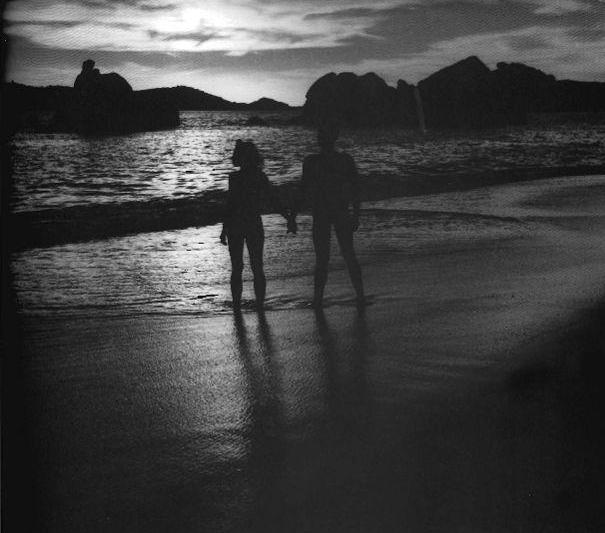
At any rate, and in similar b&w fashion, presented in a rival medium and possessed of a noir of a different color, is Lola Alvarez Bravo’s classic Acapulco en el Sueño. My limited facility with Spanish precludes my appreciating the poetry and beauty of Francisco Tario’s accompanying text, much less commenting on it. But in any case with books like these it’s really the photography that’s the thing, and what photography!

With its haunting, shades-of-gray images, Sueño is an eclectic, unlikely paean to Acapulco’s epoca de oro -- the pre-spoiled years of the late 1940s when there was an abundance of charm and a minimum of mass tourism. It’s all there in the varying portraits of the beautiful people (in both senses of the term); slyly candid scenes of gringo tourists; fishermen at work; and most of all, vistas of pristine, natural landscapes, capturing the natural beauty of Acapulco in monochromatic splendor. The silkscreen image on the cover of the original 1951 edition was done by the famed Guatemalan painter Carlos Mérida.


See also : Elizabeth Ferrer, Lola Alvarez Bravo, N. Y., Aperture, 2006; Tario al pique.


[1] The redoubtable IMDB also cites such unlikely classics as Treasure of the Sierra Madre and Captain from Castille as deriving at least in part from Acapulco and its environs.

[2] Past has at least a few scenes which were filmed there, so credited by the aforementioned IMDB.

[3] I always want to say moonlight; it seems more romantic.

[4] Perhaps lacking Past’s poetry and atmosphere, Shanghai nonetheless has an even stronger claim to on-location status, with a significant portion of the middle of the film being comprised of several quintessentially Wellesian scenes set in craggy, windswept cliffs and hills shot at various off-kilter angles.


Thursday, August 5, 2010

Las reinas de las rumberas


Las reinas del trópico: María Antonieta Pons, Meche Barba, Amalia Aguilar, Ninón Sevilla, Rosa Carmina, by Fernando Muñoz Castillo. [México, D.F.] : Grupo Azabache, 1993. "Se termino de imprimir en julio de 1993 en Offset 70, S.A. de C.V., Victor Hugo 99, Mexico,03300, D.F."

Las reinas del trópico is a loving pictorial tribute to the five Latina actresses* in the book's subtitle, focusing on their spicy dance numbers in the rumberas (aka cabaretera) cinematic genre popular in the 1940s and 1950s. In the context of cine negro the book is also noteworthy for its many tasty and very noirish photos of the (non-cabaret) scenes from individual films. See also : Rumberas cubanas, reinas en el cine.


*
They all attained fame in Mexican films but only one of them (Meche Barba) was actually of Mexican descent
.


Sunday, May 23, 2010

Mexico and the Blacklist. Postscript : A 'Touch' of the Red Scare. Part 1

 
Despite his rather well-known liberal political views, Orson Welles was never a victim of the Blacklist [1]. Though he had already been denounced as a Communist sympathizer by the Hearst press, the official targeting of Welles was hardly necessary, given his (more or less) self-imposed Hollywood exile during the Blacklist’s peak years of 1947 to 1957. Welles’s absence during these years might have been partially due to his discomfort with the prevailing tenor of the times, but the more likely explanation was his reputation for not playing the filmmaking game by the established Hollywood rules, his supposed transgressions being, among others, extravagance and unpredictability. The result was a paucity of directorial engagements. Thus Welles’s was a political sort of blacklisting, but not of the ideological kind.


Elsewhere in this blog we’ve discussed Touch of Evil as a prime example of border-noir, in particular focusing on its border/racial issues and the complexly textured character of Capt. Quinlan. In this posting we’ll consider Touch of Evil in the context of the Red Scare of the 1950s. The film indeed reeks of a malodorous if rather unfocused malevolence [2], created and sustained by its sounds, bumpy narrative, character grotesques, sleazy music, low rent settings, and murky – even by noirish standards – look.

More specifically, Touch of Evil is about – among other things – racism and American supremacism, and the corresponding haves and have-nots on both sides of the border. But it’s also about the police, police corruption, state terror and the abuse of official power, all themes that resonate within a McCarthy-esque gestalt in the film’s context of the 1950s.

On one level Evil can be read as a Red Scare parable where Quinlan and the entire ‘Los Robles’ police apparatus stand in for HUAC/McCarthy-like forces of official heavy-handedness, where the Mexicans, small time criminals, and otherwise powerless and marginalized individuals - for whom questionable associations and even suspicion of wrongdoing were tantamount to guilt - represent the victims of the Cold War’s most egregious paranoiac excesses. The apt setting is the phantasmagoric, border town universe of Los Robles, which nicely fills in as an extreme manifestation of American society in the 1950s. “If border towns do bring out the worst in countries, perhaps, then, they are metaphors for what those countries really are.” (Krueger, p. 57).


Filmed in 1957 and released the following year, Touch of Evil is often cited as the book-ending apotheosis of the noir era [3]. It’s also fair to think of the years 1957-1959, or thereabouts, as the unofficial end of the Blacklist. The late Fifties’ more progressive bent was further evidenced by the growing momentum of the Civil Rights movement. But perhaps most important, 1957 also witnessed the passing of Sen. Joseph McCarthy, and it’s perhaps no accident that the character of Quinlan - scowling, unkempt, singularly un-photogenic - bears a strong metaphorical (and physical) resemblance to McCarthy.  
'Touch' of the Red Scare Part 2 here

Friday, May 21, 2010

Mexico and the Blacklist. Postscript : A 'Touch' of the Red Scare. Part 2


'Touch' of the Red Scare Part 1 here

   Thus, in Touch of Evil, a McCarthy-esque Quinlan bullies, accuses, cajoles and generally hogs the spotlight, but ultimately his fate is that of gradual self-destruction, and by the end of the film he has been duly pilloried and dispatched. And to be fair, the resemblance extends to Welles himself, as is witnessed by the frequent critical commentary on similarities between Welles and the Quinlan character [4]. This is underscored further in that the character of Quinlan, and  McCarthy, lacked the discipline, plodding methodology, and intellectual rigor for sustained and meaningful results; instead they relied on a few brilliant flourishes buttressed by theatrical bombast, half-baked intuition, and the convenient stage management of facts [5]. Both surrounded themselves with fawning toadies who would not dare question their brilliance, extending in Quinlan's case to even his nominal superiors. (As for Welles, the admirers continue to this day in the form of critics, academics, and other devotees).

   And to be sure, Evil's flawed hero Quinlan – warts and all in the form of his racial prejudice and physical repulsiveness – on a superficial level fits the stereotype of a Southern redneck sheriff. Indeed, In the Heat of the Night’s iconic good old boy sheriff of a decade later, played by Rod Steiger, might well have been based on the Hank Quinlan template. [Moreover, as a symbol of heavy-handed 1950s officialdom, Quinlan bears more than a passing resemblance to J. Edgar Hoover.]

  But on the other hand Quinlan is, disquietingly, a surprisingly sympathetic character, partially due to his prowess as a detective, but mostly for the fact that it’s his  methods which are objectionable, not his motivations or results. As a contrast we have his nemesis, the Mexican good cop Vargas, who despite his nobility and insistence on legal process, remains a curiously unlikable character, in part because of his self-righteousness, but also because his methods eventually descend to Quinlan-like levels of unsavoriness.

  These multilayered character touches are reminders that there are no easy interpretations or answers in Touch of Evil. Everything about it – especially its look and characters – are posited in innumerable shadings, creating a moral and physical universe that’s ambiguous at best and irretrievably corrupt at worst. With its uneasy synthesis of sordidness, redemption, corruption and compassion, and especially through its themes of border tensions, racial prejudice, and fear of the Other, Touch of Evil has an uncanny prescience, and continues to fascinate and resonate – and grow in popularity – in our own unquiet times.


[1] A counter point of view is provided by Joseph McBride’s What Ever Happened to Orson Welles? : a Portrait of an Independent Career [Lexington, University Press of Kentucky, 2006], which forcefully makes the case for Welles as victim of McCarthyism and the Blacklist, citing Welles’s genuine commitment to social causes in the 1930s and 1940s, as well as the FBI files collected on Welles from 1941 to 1954.

[2] In this context we note Eric M. Krueger’s perspicacious analysis of Touch of Evil’s garbage and filth-infested motifs, as metaphor for the story’s all-pervasive corruption and decay (and perhaps as a metaphor for a touch of the Red Scare?). E. M. Krueger, “Touch of Evil : Style Expressing Content,” Cinema Journal, Vol. 12, No. 1 (Autumn 1972), pp. 57-58.

[3] Kemp points out that it's no coincidence that the decline of the classic noir cycle follows closely on the fall of McCarthy. Philip Kemp, "From the Nightmare Factory: HUAC and the Politics of Noir," Sight & Sound v55, 1986, p270.

[4] By the late 1950s Welles was no longer the dapper figure of his Boy Wonder days. True, he had not quite descended to Quinlan-esque levels of bloated grotesqueness, but he was showing the first signs of the extreme overweight that would make him a self-caricature in his later years.

[5] It’s perhaps no accident that Welles, in additional to being a great director, was also a talented, near professional-caliber magician. Accordingly, there's a goodly amount of magic present in his directorial style, with more than it's share of sleight-of hand conjuring tricks.


Wednesday, May 5, 2010

Mexico and the Blacklist

For all its vaunted black & white visuals, film noir was not a unique phenomenon; there were scores of movies being made in the 1940s, and even earlier, that, shadow for shadow, angle for angle, had all the look of noir but could hardly be called film noir [1]. What makes the genre black is something more elusive -- a mood, angst, or zeitgeist, call it what you will [2]. Perversely, then, a defining feature of noir is a certain undefined menace, always lurking subliminally in the background, overlaying every scene with a larded sense of dread. The smell of fear, perhaps, as one writer so famously put it.

And while it may be an oversimplification to invoke the much-used term paranoia [3], certainly the Red Scare which coincided with the noir heyday of the late 1940s and early 1950s was a major contributing ingredient, ubiquitously fanning the flames of suspicion, recriminations and counter-recriminations, and in the process infusing the noir universe with its own special brand of pungent atmospherics.

To wit - and in one of the more infelicitous coincidences in film history - it happened that many of the artists who came to be associated with what we today call film noir tended toward the Left in their political sympathies [4]. Suffice to say that the Congressional investigations into ‘subversive’ elements in the film industry had an especially telling impact on the writers, editors, directors and actors who worked in film noir [5], in the process ruining, shortening or compromising entire careers, and in some cases, shortening lives.

Paraphrasing Raymond Chandler yet again, American society in the late 1940s and early 1950s had become dark with something more than night. As a result, Mexico and France in particular became popular alternatives for those who wished to escape the accusatory atmosphere of the times, especially those who found themselves under the watchful eye of the Red Scare police. The refugees on the Hollywood blacklist, as well as intellectuals and artists in other contexts, who ‘escaped’ to Mexico [6], continued to eke out a living, as screenwriters, ghostwriters, actors, directors, etc., or they worked in related fields, in any case under varying, usually greatly reduced circumstances (Gordon, p. 33).

There’s a further, rather cruel irony in that a common theme in American films noirs, to the point of cliché, is the notion of escape to Mexico. For the blacklistees, however, the flight to Mexico was a transmogrified, real-life variation on the noir formula. Their crime had been ideological incorrectness, and - however imperfect - Mexico represented a welcome refuge in an ever-unforgiving, indeed, noirish universe.

[1] Just a few examples : Casablanca, The Ghost and Mrs. Muir, Uninvited, The Black Cat, The Song of Bernadette, The Razor’s Edge, 39 Steps, The Picture of Dorian Gray, Cat People, Since You Went Away, Brief Encounter.

[2] As one source puts it : "Film noir reflected an existential dread far deeper than politics could encompass. ‘The death of God’ gets closer to expressing this than ‘the corruption of Capitalism’." (Film noir and the Death of God and More on Film Noir and the Death of God).

[3] For more on Cold War nuclear paranoia in particular and its connection to film noir, see : Mark Osteen, “The Big Secret : Film Noir and Nuclear Fear,” Journal of Popular Film and Television 22(2), Summer 1994, pp79-90; and Walter Metz, ''Keep the Coffee Hot, Hugo” : Nuclear Trauma in Lang's The Big Heat, Film Criticism, 21(3), Spring 1997, pp43-65.


[4] The resultant House Un-American Activities Committee's persecution of progressive actors, directors and especially writers has been dealt with in detail elsewhere. The many books include : Thomas Doherty, Cold War, Cool Medium : Television, McCarthyism, and American Culture, New York, Columbia University Press, 2003; Patrick McGilligan and Paul Buhle, Tender Comrades : a Backstory of the Hollywood Blacklist, New York,  St. Martin's Press, 1997; "Un-American" Hollywood : Politics and Film in the Blacklist Era, edited by Frank Krutnik [et al.], New Brunswick, N.J., Rutgers University Press, 2007; Paul Buhle and Dave Wagner, Hide in Plain Sight : the Hollywood Blacklistees in Film and Television, 1950-2002, New York, Palgrave Macmillan, 2003; Reynold Humphries, Hollywood's Blacklists : a Political and Cultural History, Edinburgh, Edinburgh University Press, 2008. See also : Philip Kemp, "From the Nightmare Factory : HUAC and the Politics of Noir," Sight & Sound v55 (1986), pp266-270.


[5] Two good analyses of film noir and the Blacklist can be found here and here. And there’s a nice collection of articles and posts at The Hollywood Left and the Blacklist Era. Two good books on film noir and its connection to the Red Scare are : Wheeler Winston Dixon, Film Noir and the Cinema of Paranoia (New Brunswick, N.J., Rutgers University Press, 2009); and Ray Pratt, Projecting Paranoia : Conspiratorial Visions in American Film, (Lawrence, University Press of Kansas, 2001). See also : Handwringing Over Mass Culture 1950-1959, a Chronology, by Richard Keller Simon.


[6] There’s an extensive literature on Mexico exiles and the prevailing culture of the times. The best source is Rebecca M. Schreiber’s richly detailed Cold War Exiles in Mexico : U.S. Dissidents and the Culture of Critical Resistance (Minneapolis, University of Minnesota Press, 2008), which covers visual artists and writers as well as filmmakers, and in addition examines African Americans fleeing racial prejudice. Other sources include Bernard Gordon, Hollywood Exile, or, How I Learned to Love the Blacklist : a Memoir, Austin, University of Texas Press, 1999; and Diana Anhalt, A Gathering of Fugitives: American Political Expatriates in Mexico 1948-1965 (Archer, 2001).

Friday, April 2, 2010

Our Man in Mexico


Morley, Jefferson. Our man in Mexico : Winston Scott and the hidden history of the CIA. Foreword by Michael Scott. Lawrence : University Press of Kansas, 2008.


The Mexico connection 
In the 1940s and 1950s a different kind of noir engulfed the U.S. and the entire Western world -- the specter of the Cold War, with all its attendant Red Scare paranoia and uncertainty. Because of its strategic pole position in the Cold War sweepstakes, Mexico came in for special attention from both sides. This was due mostly to Mexico’s status as gateway to Latin America as well as its proximity to Cuba. With the U.S. government’s near-pathological concern over Leftist uprisings in the Americas, it’s not difficult to see why Mexico City achieved such prominence.

The hero of our story is Winston Scott, CIA career officer, eventual Mexico City station chief, and a man of surprising shadings and complexities [1]. A strict taskmeister on the job but a coddling father at home, Scott had a picaresque temperament which metamorphosed into a certain suave, business-like exterior which served him well in his diplomatic cover. The downside was a predilection for inconvenient romantic entanglements which seemed to inspire the dreamy poetry he wrote during off-hours. A good soldier and true believer who was entrusted with the most sensitive assignment in the Western hemisphere, he nonetheless was left out of the loop by his Washington masters on matters relating to JFK's assassination, and he eventually came to have considerable doubts about the agency [2]. Tellingly, his memoirs, unpublished at the time of his death, were considered so potentially explosive that legendary spymaster James Angleton rushed to Mexico City only a few days after Scott’s death to whisk away the originals plus any copies, taking them back to Washington for safe keeping. Even today, four decades later, they’ve not seen the light of day [3].

Not quite conspiracist

Thus, on one level the book is a straightforward narrative of Scott’s life and colorful career, with especially good coverage of his years in Britain in WWII and his acquaintance with one Kim Philby. It also gives us a good flavor of social and political life in Mexico City the 50s and 60s (“Casablanca of the Cold War”). But the centerpiece of the story is of course Lee Harvey Oswald’s visit to Mexico City in late September and early October of 1963 [4]. The two oustanding issues raised by the book seem to be the CIA's advance, pre-assassination knowledge of Oswald generally, and in particular the degree to which the Mexico office was or was not involved in monitoring his activities there. There’s lots of facts to ponder and dots to connect, but the evidence – as ever, maddeningly incomplete and fragmentary – suggests more than it delivers. Lots of good stuff, but no smoking guns [5]. But even with these imperfections, Our Man in Mexico makes a substantial contribution to JFK assassination studies and will give historians and general readers plenty to chew over.

[1] Not so surprisingly, considering his line of work, Scott ultimately remains a mystery and enigma.
[2] Scott’s misgivings about the agency were primarily regarding its organization and management style, not necessarily its philosophy or mission. In this respect he was a true believer to the end.
[3] To be sure, about one half of Scott’s memoirs have been released publically. The only complete copies of the original manuscript, however, remain at CIA headquarters. 

[4] An alternate, conspiracist version of the events - not necessarily endorsed by Morley - posits that the man who visited Mexico City was an Oswald double or impersonator. 
[5] In a recent article on the subject, author Morely seems to lean toward a conspiracist interpretation.