Sunday, May 23, 2010
Mexico and the Blacklist. Postscript : A 'Touch' of the Red Scare. Part 1
Despite his rather well-known liberal political views, Orson Welles was never a victim of the Blacklist [1]. Though he had already been denounced as a Communist sympathizer by the Hearst press, the official targeting of Welles was hardly necessary, given his (more or less) self-imposed Hollywood exile during the Blacklist’s peak years of 1947 to 1957. Welles’s absence during these years might have been partially due to his discomfort with the prevailing tenor of the times, but the more likely explanation was his reputation for not playing the filmmaking game by the established Hollywood rules, his supposed transgressions being, among others, extravagance and unpredictability. The result was a paucity of directorial engagements. Thus Welles’s was a political sort of blacklisting, but not of the ideological kind.
Elsewhere in this blog we’ve discussed Touch of Evil as a prime example of border-noir, in particular focusing on its border/racial issues and the complexly textured character of Capt. Quinlan. In this posting we’ll consider Touch of Evil in the context of the Red Scare of the 1950s. The film indeed reeks of a malodorous if rather unfocused malevolence [2], created and sustained by its sounds, bumpy narrative, character grotesques, sleazy music, low rent settings, and murky – even by noirish standards – look.
More specifically, Touch of Evil is about – among other things – racism and American supremacism, and the corresponding haves and have-nots on both sides of the border. But it’s also about the police, police corruption, state terror and the abuse of official power, all themes that resonate within a McCarthy-esque gestalt in the film’s context of the 1950s.
On one level Evil can be read as a Red Scare parable where Quinlan and the entire ‘Los Robles’ police apparatus stand in for HUAC/McCarthy-like forces of official heavy-handedness, where the Mexicans, small time criminals, and otherwise powerless and marginalized individuals - for whom questionable associations and even suspicion of wrongdoing were tantamount to guilt - represent the victims of the Cold War’s most egregious paranoiac excesses. The apt setting is the phantasmagoric, border town universe of Los Robles, which nicely fills in as an extreme manifestation of American society in the 1950s. “If border towns do bring out the worst in countries, perhaps, then, they are metaphors for what those countries really are.” (Krueger, p. 57).
Filmed in 1957 and released the following year, Touch of Evil is often cited as the book-ending apotheosis of the noir era [3]. It’s also fair to think of the years 1957-1959, or thereabouts, as the unofficial end of the Blacklist. The late Fifties’ more progressive bent was further evidenced by the growing momentum of the Civil Rights movement. But perhaps most important, 1957 also witnessed the passing of Sen. Joseph McCarthy, and it’s perhaps no accident that the character of Quinlan - scowling, unkempt, singularly un-photogenic - bears a strong metaphorical (and physical) resemblance to McCarthy.
'Touch' of the Red Scare Part 2 here
Friday, May 21, 2010
Mexico and the Blacklist. Postscript : A 'Touch' of the Red Scare. Part 2
'Touch' of the Red Scare Part 1 here
Thus, in Touch of Evil, a McCarthy-esque Quinlan bullies, accuses, cajoles and generally hogs the spotlight, but ultimately his fate is that of gradual self-destruction, and by the end of the film he has been duly pilloried and dispatched. And to be fair, the resemblance extends to Welles himself, as is witnessed by the frequent critical commentary on similarities between Welles and the Quinlan character [4]. This is underscored further in that the character of Quinlan, and McCarthy, lacked the discipline, plodding methodology, and intellectual rigor for sustained and meaningful results; instead they relied on a few brilliant flourishes buttressed by theatrical bombast, half-baked intuition, and the convenient stage management of facts [5]. Both surrounded themselves with fawning toadies who would not dare question their brilliance, extending in Quinlan's case to even his nominal superiors. (As for Welles, the admirers continue to this day in the form of critics, academics, and other devotees).
And to be sure, Evil's flawed hero Quinlan – warts and all in the form of his racial prejudice and physical repulsiveness – on a superficial level fits the stereotype of a Southern redneck sheriff. Indeed, In the Heat of the Night’s iconic good old boy sheriff of a decade later, played by Rod Steiger, might well have been based on the Hank Quinlan template. [Moreover, as a symbol of heavy-handed 1950s officialdom, Quinlan bears more than a passing resemblance to J. Edgar Hoover.]
But on the other hand Quinlan is, disquietingly, a surprisingly sympathetic character, partially due to his prowess as a detective, but mostly for the fact that it’s his methods which are objectionable, not his motivations or results. As a contrast we have his nemesis, the Mexican good cop Vargas, who despite his nobility and insistence on legal process, remains a curiously unlikable character, in part because of his self-righteousness, but also because his methods eventually descend to Quinlan-like levels of unsavoriness.
These multilayered character touches are reminders that there are no easy interpretations or answers in Touch of Evil. Everything about it – especially its look and characters – are posited in innumerable shadings, creating a moral and physical universe that’s ambiguous at best and irretrievably corrupt at worst. With its uneasy synthesis of sordidness, redemption, corruption and compassion, and especially through its themes of border tensions, racial prejudice, and fear of the Other, Touch of Evil has an uncanny prescience, and continues to fascinate and resonate – and grow in popularity – in our own unquiet times.
[1] A counter point of view is provided by Joseph McBride’s What Ever Happened to Orson Welles? : a Portrait of an Independent Career [Lexington, University Press of Kentucky, 2006], which forcefully makes the case for Welles as victim of McCarthyism and the Blacklist, citing Welles’s genuine commitment to social causes in the 1930s and 1940s, as well as the FBI files collected on Welles from 1941 to 1954.
[2] In this context we note Eric M. Krueger’s perspicacious analysis of Touch of Evil’s garbage and filth-infested motifs, as metaphor for the story’s all-pervasive corruption and decay (and perhaps as a metaphor for a touch of the Red Scare?). E. M. Krueger, “Touch of Evil : Style Expressing Content,” Cinema Journal, Vol. 12, No. 1 (Autumn 1972), pp. 57-58.
[3] Kemp points out that it's no coincidence that the decline of the classic noir cycle follows closely on the fall of McCarthy. Philip Kemp, "From the Nightmare Factory: HUAC and the Politics of Noir," Sight & Sound v55, 1986, p270.
[4] By the late 1950s Welles was no longer the dapper figure of his Boy Wonder days. True, he had not quite descended to Quinlan-esque levels of bloated grotesqueness, but he was showing the first signs of the extreme overweight that would make him a self-caricature in his later years.
[5] It’s perhaps no accident that Welles, in additional to being a great director, was also a talented, near professional-caliber magician. Accordingly, there's a goodly amount of magic present in his directorial style, with more than it's share of sleight-of hand conjuring tricks.
Wednesday, May 5, 2010
Mexico and the Blacklist
And while it may be an oversimplification to invoke the much-used term paranoia [3], certainly the Red Scare which coincided with the noir heyday of the late 1940s and early 1950s was a major contributing ingredient, ubiquitously fanning the flames of suspicion, recriminations and counter-recriminations, and in the process infusing the noir universe with its own special brand of pungent atmospherics.
To wit - and in one of the more infelicitous coincidences in film history - it happened that many of the artists who came to be associated with what we today call film noir tended toward the Left in their political sympathies [4]. Suffice to say that the Congressional investigations into ‘subversive’ elements in the film industry had an especially telling impact on the writers, editors, directors and actors who worked in film noir [5], in the process ruining, shortening or compromising entire careers, and in some cases, shortening lives.
Paraphrasing Raymond Chandler yet again, American society in the late 1940s and early 1950s had become dark with something more than night. As a result, Mexico and France in particular became popular alternatives for those who wished to escape the accusatory atmosphere of the times, especially those who found themselves under the watchful eye of the Red Scare police. The refugees on the Hollywood blacklist, as well as intellectuals and artists in other contexts, who ‘escaped’ to Mexico [6], continued to eke out a living, as screenwriters, ghostwriters, actors, directors, etc., or they worked in related fields, in any case under varying, usually greatly reduced circumstances (Gordon, p. 33).
There’s a further, rather cruel irony in that a common theme in American films noirs, to the point of cliché, is the notion of escape to Mexico. For the blacklistees, however, the flight to Mexico was a transmogrified, real-life variation on the noir formula. Their crime had been ideological incorrectness, and - however imperfect - Mexico represented a welcome refuge in an ever-unforgiving, indeed, noirish universe.
[2] As one source puts it : "Film noir reflected an existential dread far deeper than politics could encompass. ‘The death of God’ gets closer to expressing this than ‘the corruption of Capitalism’." (Film noir and the Death of God and More on Film Noir and the Death of God).
[3] For more on Cold War nuclear paranoia in particular and its connection to film noir, see : Mark Osteen, “The Big Secret : Film Noir and Nuclear Fear,” Journal of Popular Film and Television 22(2), Summer 1994, pp79-90; and Walter Metz, ''Keep the Coffee Hot, Hugo” : Nuclear Trauma in Lang's The Big Heat, Film Criticism, 21(3), Spring 1997, pp43-65.
[4] The resultant House Un-American Activities Committee's persecution of progressive actors, directors and especially writers has been dealt with in detail elsewhere. The many books include : Thomas Doherty, Cold War, Cool Medium : Television, McCarthyism, and American Culture, New York, Columbia University Press, 2003; Patrick McGilligan and Paul Buhle, Tender Comrades : a Backstory of the Hollywood Blacklist, New York, St. Martin's Press, 1997; "Un-American" Hollywood : Politics and Film in the Blacklist Era, edited by Frank Krutnik [et al.], New Brunswick, N.J., Rutgers University Press, 2007; Paul Buhle and Dave Wagner, Hide in Plain Sight : the Hollywood Blacklistees in Film and Television, 1950-2002, New York, Palgrave Macmillan, 2003; Reynold Humphries, Hollywood's Blacklists : a Political and Cultural History, Edinburgh, Edinburgh University Press, 2008. See also : Philip Kemp, "From the Nightmare Factory : HUAC and the Politics of Noir," Sight & Sound v55 (1986), pp266-270.
[5] Two good analyses of film noir and the Blacklist can be found here and here. And there’s a nice collection of articles and posts at The Hollywood Left and the Blacklist Era. Two good books on film noir and its connection to the Red Scare are : Wheeler Winston Dixon, Film Noir and the Cinema of Paranoia (New Brunswick, N.J., Rutgers University Press, 2009); and Ray Pratt, Projecting Paranoia : Conspiratorial Visions in American Film, (Lawrence, University Press of Kansas, 2001). See also : Handwringing Over Mass Culture 1950-1959, a Chronology, by Richard Keller Simon.
Friday, April 2, 2010
Our Man in Mexico
In the 1940s and 1950s a different kind of noir engulfed the U.S. and the entire Western world -- the specter of the Cold War, with all its attendant Red Scare paranoia and uncertainty. Because of its strategic pole position in the Cold War sweepstakes, Mexico came in for special attention from both sides. This was due mostly to Mexico’s status as gateway to Latin America as well as its proximity to Cuba. With the U.S. government’s near-pathological concern over Leftist uprisings in the Americas, it’s not difficult to see why Mexico City achieved such prominence.
The hero of our story is Winston Scott, CIA career officer, eventual Mexico City station chief, and a man of surprising shadings and complexities [1]. A strict taskmeister on the job but a coddling father at home, Scott had a picaresque temperament which metamorphosed into a certain suave, business-like exterior which served him well in his diplomatic cover. The downside was a predilection for inconvenient romantic entanglements which seemed to inspire the dreamy poetry he wrote during off-hours. A good soldier and true believer who was entrusted with the most sensitive assignment in the Western hemisphere, he nonetheless was left out of the loop by his Washington masters on matters relating to JFK's assassination, and he eventually came to have considerable doubts about the agency [2]. Tellingly, his memoirs, unpublished at the time of his death, were considered so potentially explosive that legendary spymaster James Angleton rushed to Mexico City only a few days after Scott’s death to whisk away the originals plus any copies, taking them back to Washington for safe keeping. Even today, four decades later, they’ve not seen the light of day [3].
Not quite conspiracist
Thus, on one level the book is a straightforward narrative of Scott’s life and colorful career, with especially good coverage of his years in Britain in WWII and his acquaintance with one Kim Philby. It also gives us a good flavor of social and political life in Mexico City the 50s and 60s (“Casablanca of the Cold War”). But the centerpiece of the story is of course Lee Harvey Oswald’s visit to Mexico City in late September and early October of 1963 [4]. The two oustanding issues raised by the book seem to be the CIA's advance, pre-assassination knowledge of Oswald generally, and in particular the degree to which the Mexico office was or was not involved in monitoring his activities there. There’s lots of facts to ponder and dots to connect, but the evidence – as ever, maddeningly incomplete and fragmentary – suggests more than it delivers. Lots of good stuff, but no smoking guns [5]. But even with these imperfections, Our Man in Mexico makes a substantial contribution to JFK assassination studies and will give historians and general readers plenty to chew over.
[1] Not so surprisingly, considering his line of work, Scott ultimately remains a mystery and enigma.
[2] Scott’s misgivings about the agency were primarily regarding its organization and management style, not necessarily its philosophy or mission. In this respect he was a true believer to the end.
[3] To be sure, about one half of Scott’s memoirs have been released publically. The only complete copies of the original manuscript, however, remain at CIA headquarters.
[4] An alternate, conspiracist version of the events - not necessarily endorsed by Morley - posits that the man who visited Mexico City was an Oswald double or impersonator.
[5] In a recent article on the subject, author Morely seems to lean toward a conspiracist interpretation.
Tuesday, March 2, 2010
Border noir II : Kansas City Confidential (1952)
Kansas City Confidential (1952); Associated Players and Producers presents; an Edward Small production; George Bruce, Harry Essex, writers; story by Harold R. Green and Rowland Brown; directed by Phil Karlson. With John Payne, Lee Van Cleef, Coleen Gray, Preston Foster, Neville Brand, Jack Elam, Dona Drake, Mario Siletti. Cinematography by George E. Diskant; art director, Edward L. Ilou; editor, Buddy Small; music, Paul Sawtell. Summary: An armored car robbery is pulled off and four robbers get away clean with 1.2 million in cash. However - a decorated and down on his luck veteran named Joe Rolfe is accused of being involved and is mercilessly grilled by the local police. Released, Joe plots his revenge of the thieves.
Kansas City Confidential isn't exactly border noir, in fact a lot of it isn’t really very noirish. But it’s a tasty little heist movie, and for me the best scenes, only a few minutes of footage alas, take place in that whipping boy of vice-ridden, danger-infested border towns, "the wickedest city in the world," Tijuana. Not the real Tijuana but a cleverly designed set of the type the studios did so well back in the day. In fact, this Tijuana - an irresistible haze of dimly lit back alleys, gambling parlors, neon lights and unsavory characters - seems more authentic and atmospheric than the real thing.
Anyway, the most noirish sequence may well be John Payne’s roughing up a sweaty and nervous Jack Elam in the seediest of hotel rooms. The scenes in Tijuana fly by far too fast, and before we know it, the movie changes gears and moves to a fictitious, and very unconvincing, resort setting, where, from a purely noir perspective, it’s far less interesting, though a fair amount of tension in the story is maintained.
KCC is virtually a textbook on how to fashion a classy B noir: cast, music, look, and direction are first-rate. Similar in tone and content to Asphalt Jungle of a couple of years prior, but not quite as good, KCC benefits from a cast of noir mainstays: tough guy hero-with-a-past John Payne; heist mastermind Preston Foster; good girl Coleen Gray; and perhaps best of all, quintessential baddies Lee Van Cleef, Jack Elam and Neville Brand.
substance ***
Tuesday, February 16, 2010
arqueológico noir
Plunder of the sun
[DVD]. Warner
Bros. presents a Wayne-Fellows production; produced by Robert Fellows;
screenplay by Jonathan Latimer; directed by John Farrow. Based on the novel by
David Dodge. Originally released as a motion picture in 1953. Special features:
Commentary by Peter Ford and Frank Thompson; On location with Glenn Ford; Sean
McClory; Plundering history. Performers: Glenn Ford, Diana Lynn, Patricia
Medina, Francis Sullivan.style ***
substance ***
exotic noir
Film noir buffs are divided as to whether Plunder of the Sun is genuine noir or not. I include it here because of its heist/missing treasure plot and its shadowy look (the latter is actually quite strikingly done; kudos to director John Farrow and cinematographer Jack Draper). Two more strengths: 1) it’s refreshing to see a movie about Mexican archaeology that’s not a horror film; 2) the novelty of the filming locations (Oaxaca, Mitla and Monte Alban).
Looking great at forty-ish, Glenn Ford is solid as always. Here he's part villain and part hero, and seems bemused much of the time as he tries to locate some sort of mislaid Aztec parchment. His leading lady Patricia Medina is terrific. I’d never heard of her until this film, and her exotic looks make her perfect for the part: she's absolutely gorgeous in every scene she's in, though I was never sure, even at the end, whether she was a femme fatale or virtuous heroine.
But the great coup of the story - and the casting - is the group of eccentric characters who are sprinkled around the nominal leads: Francis Sullivan as an obsessive collector; a Gloria Graham-esque Diana Lynn as the film's de facto femme fatale; and the, alas unidentified, singer of “Sin Ella” at the saloon in Havana. Miss Lynn in particular practically steals the movie from ostensible leading lady Patricia Medina. There's also a nice cameo by Mona Barrie (her last film) as a chatty American tourist.
A curious little movie, then, alternatingly compelling and boring, and with more than a few touches of The Maltese Falcon. The real star of Plunder, of course, is the authentic Mexican atmosphere, so effectively underscored by Antonio Díaz Conde's brash, idiomatic score. In sum, Plunder of the Sun is not quite an undiscovered masterpiece, but rather a well-heeled, quasi-noir adventure film, definitely worth a watch. Raiders of the Lost Ark with feeling, if you like.
Wednesday, February 10, 2010
Femme fatale in waiting
Errol Flynn creeped her out, Elizabeth Taylor refused to be photographed alongside her, she thought up the name ‘Marilyn Monroe’ [1], but most of all wanted to make sure that Edmund O’Brien was Dead on Arrival. Born Loretta Mary Luiz in Honolulu, of Portuguese-Hawaiian-Australian extract, Laurette Luez was one of the most promising of a handful of can’t-miss starlets of the post-WWII era. Her breakthrough year seemed to be 1950, when she appeared in two good films, D.O.A. and Kim. In the former her femme fatale credentials – beauty, brains, and lots of attitude – were showcased to best advantage, but cruelly it was the harem girl role in Kim that would foreshadow her career in the 1950s, when in a rapid and inexplicable descent into B movie purgatory (most infamously in Prehistoric Women), she was invariably typecast as island girls, exotic temptresses and jungle primitives. A typical role was that of the slave-girl Karamaneh in the 1956 TV series The Adventures of Dr. Fu Manchu. By the end of the decade her career was essentially over [2]. Ironically, her last film, Ballad of a Gunfighter (1964), was actually pretty good.
What was the cause of her conspicuous cinematic non-success? Bad management, infelicitous timing, competition? Or perhaps she really didn’t have the acting talent. A more plausible explanation is that the film studios simply felt that, by the standards of the strait-laced 1950s, her dusky looks were a little too ethnic for full-fledged leading lady status. This was the post-Carmen Miranda era in Hollywood when Latino actors were very much out of fashion. In any case, in 1965 she left movies altogether to devote herself to being a full-time wife and mother, and film star Laurette Luez faded into historical obscurity. In 1999 she died at the age of 71. But through a resurgence in popularity of both film noir and 1950s camp, her star has risen once again as is witnessed by numerous affectionate blog tributes and a plethora of Web images, bringing to her a certain amount of posthumous recognition and appreciation that eluded her in her own lifetime.
[1] The MM story is quite possibly more urban legend than fact. As direct information is scarce – and others have made the claim as well – we’ll probably never know for sure.
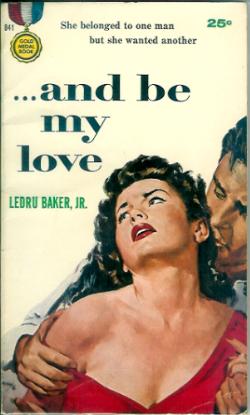
[2] To be sure, her likeness wasn’t exactly absent in her heyday years in the 1950s. As if in compensation for her disappointment in the film industry, she was much in demand as a model and for a time seemed to be a ubiquitous presence on the covers of men’s magazines. Her photogenic features even seemed to inspire pulp fiction cover art.


.jpg)